A useful first session: one zone, one return basket, one leaving-home bag, and 20 minutes. Do not empty a second zone until the first one is usable again.
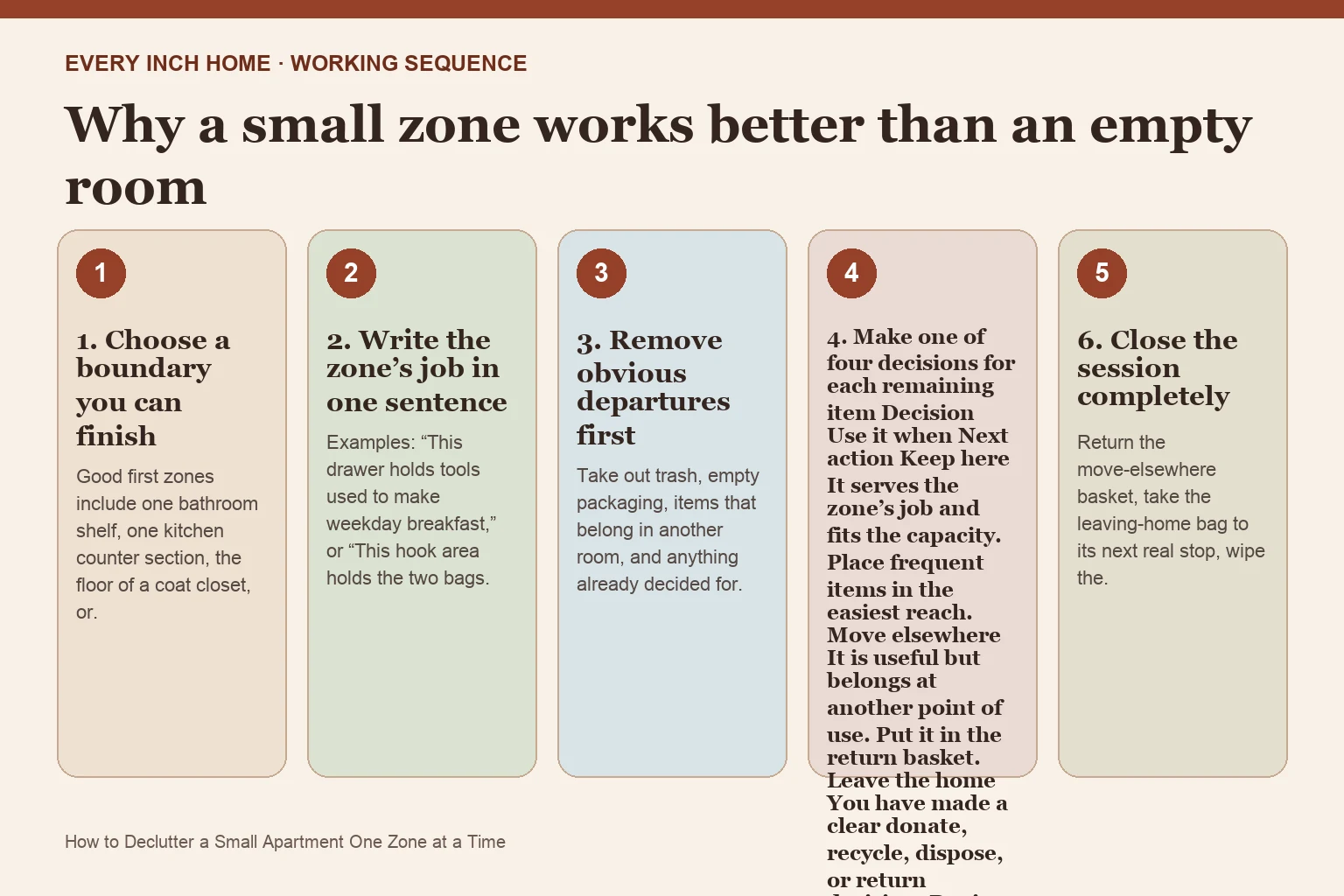
Why a small zone works better than an empty room
Emptying an entire room creates a larger sorting problem and removes the boundaries that help you decide what fits. A zone keeps the question concrete: what is this space for, what must fit here, and what needs the easiest access?
This method is not about achieving a perfectly minimal apartment. It is a way to reduce the number of unfinished decisions in your path.
The one-zone decluttering method
1. Choose a boundary you can finish
Good first zones include one bathroom shelf, one kitchen counter section, the floor of a coat closet, or the area immediately inside the front door. Avoid “the bedroom” or “all paperwork.” The boundary should be obvious enough that you know when to stop.
2. Write the zone’s job in one sentence
Examples: “This drawer holds tools used to make weekday breakfast,” or “This hook area holds the two bags that leave the apartment most often.” The job is your decision filter. An item can be useful and still belong somewhere else.
3. Remove obvious departures first
Take out trash, empty packaging, items that belong in another room, and anything already decided for donation or disposal. Do not pause to reorganize another room. Put “move elsewhere” items in one return basket and keep working inside the chosen boundary.
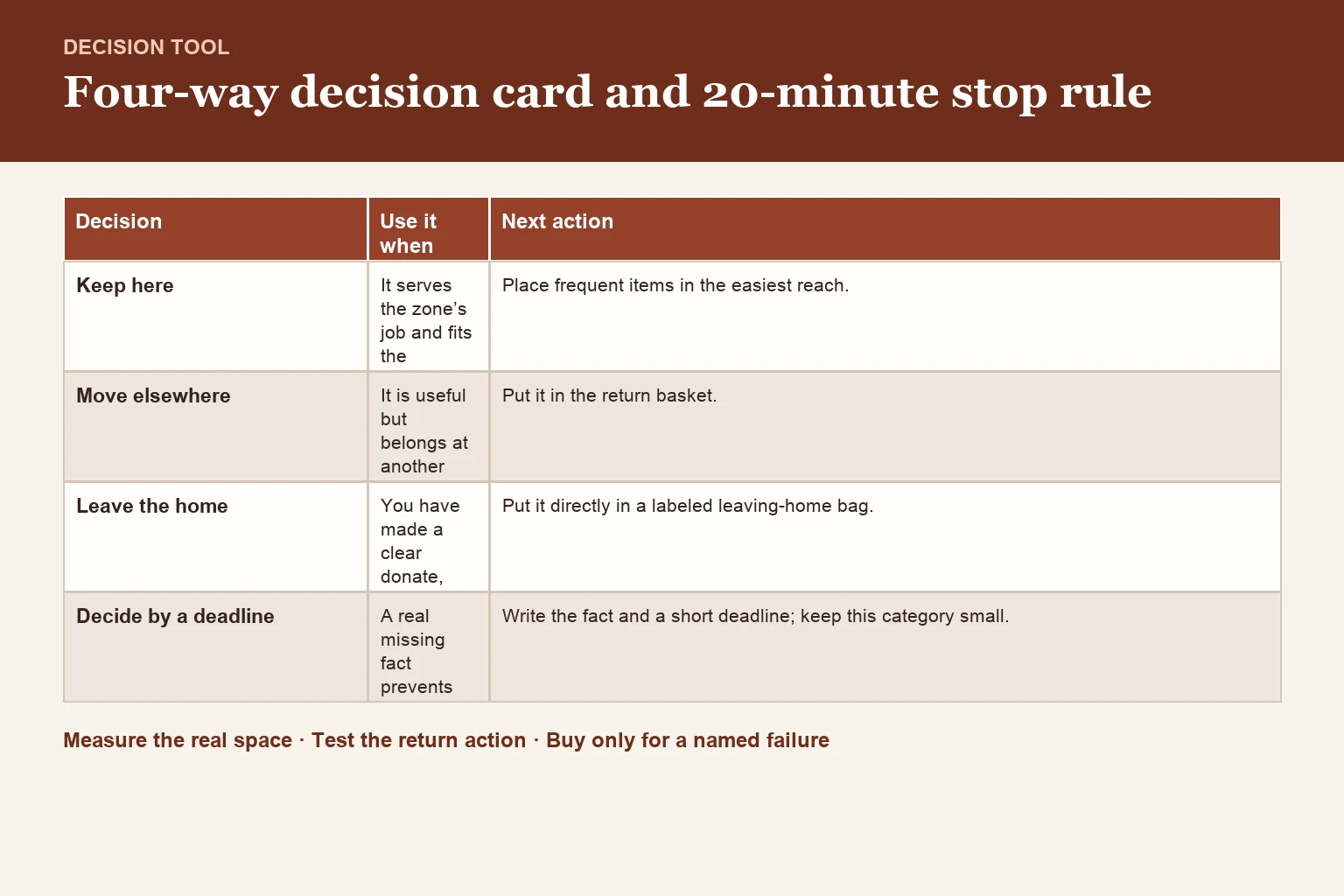
4. Make one of four decisions for each remaining item
| Decision | Use it when | Next action |
|---|---|---|
| Keep here | It serves the zone’s job and fits the capacity. | Place frequent items in the easiest reach. |
| Move elsewhere | It is useful but belongs at another point of use. | Put it in the return basket. |
| Leave the home | You have made a clear donate, recycle, dispose, or return decision. | Put it directly in a labeled leaving-home bag. |
| Decide by a deadline | A real missing fact prevents the decision. | Write the fact and a short deadline; keep this category small. |
5. Rebuild access before adding containers
Group what remains by action or use. Place current daily items first, then occasional items. Use an existing tray, box, divider, or hook if it makes return easier. If the zone still exceeds its capacity, another container will usually hide the problem rather than solve it.
6. Close the session completely
Return the move-elsewhere basket, take the leaving-home bag to its next real stop, wipe the now-accessible surface if appropriate, and photograph or note the zone’s job for reference. Closure matters more than starting a second area.
A 20-minute plan
- Minutes 0–2: choose the boundary and write its job.
- Minutes 2–7: remove trash and obvious move-elsewhere items.
- Minutes 7–15: make the four decisions.
- Minutes 15–18: rebuild frequent-to-occasional access.
- Minutes 18–20: close the return and leaving-home routes.
If the timer ends before the zone is finished, restore a safe, usable surface and schedule the same bounded zone again. Do not spread the unfinished sort across the floor.
What to declutter first in each room
- Kitchen: one counter segment or one food-storage shelf.
- Bathroom: duplicates, empty packages, and daily products without a return place.
- Closet: the easiest-reach rod or shelf, not every season at once.
- Entryway: shoes, bags, mail, and items waiting to leave.
- Living area: one recurring pile and its missing destination.
Frequently asked questions
Where should I start if every room is cluttered?
Start where one cleared zone will reduce daily friction: the route through the door, a meal-prep surface, a bathroom sink area, or the clothes you reach for each morning.
What if I might need an item later?
Name the situation, replacement difficulty, and storage cost. If a missing fact truly blocks the decision, use a small deadline box rather than an unlimited “maybe” category.
How often should I declutter a small apartment?
Use small corrective passes when a zone exceeds capacity or becomes hard to reset. A short regular review is usually easier than waiting for a whole-home project.