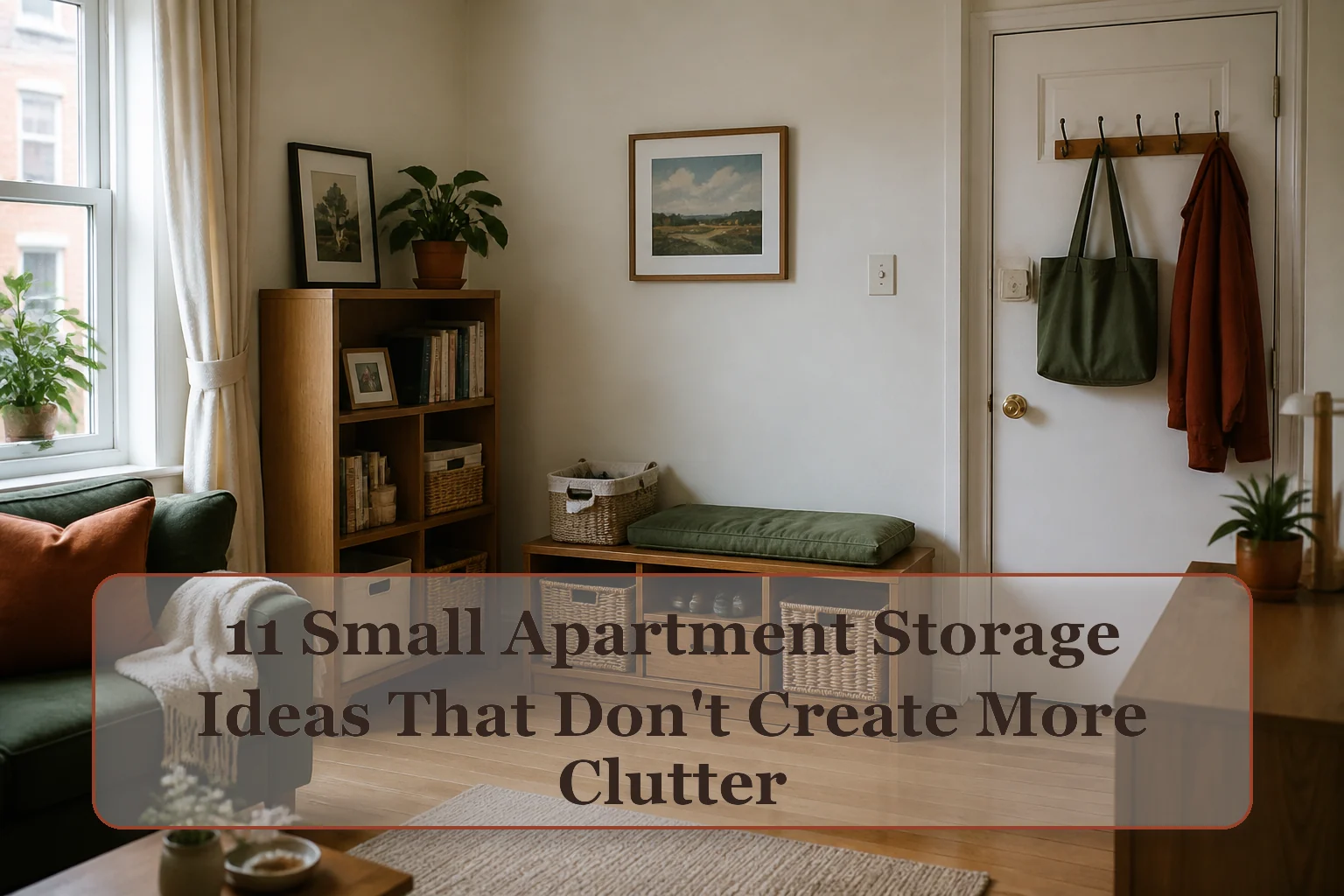
Use this order: edit what is stored → assign the easiest access → measure the gap → add the smallest useful storage. Buying comes last.
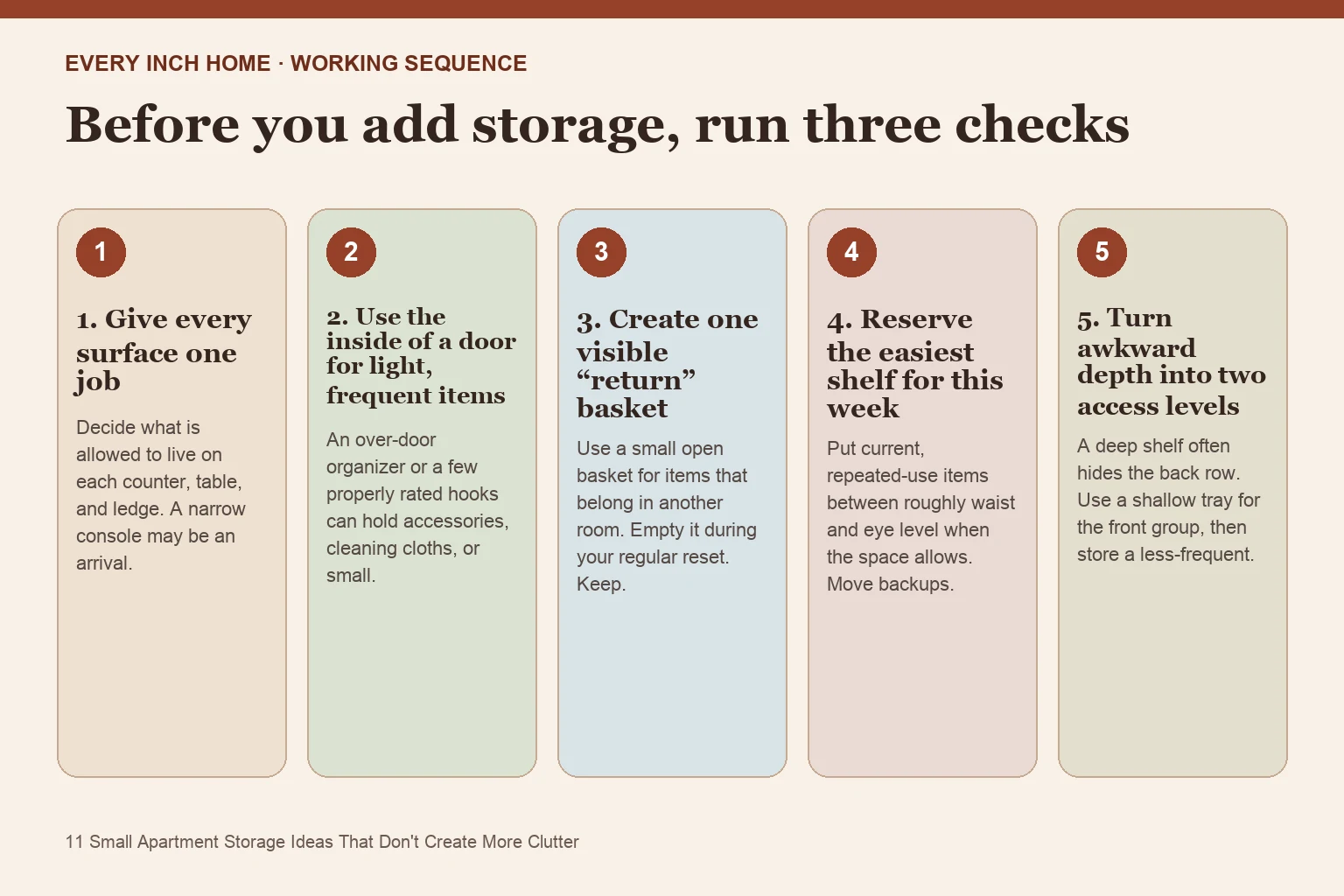
Before you add storage, run three checks
Choose one problem area—not the whole apartment—and ask:
- Capacity: Does everything in this zone reasonably fit inside its boundary?
- Access: Can you reach and return the items used most often without moving a pile?
- Reset: Can the zone return to order during an ordinary weekday?
If capacity is the problem, edit or relocate items before adding storage. If access is the problem, change placement. If reset is the problem, reduce steps: fewer lids, shorter return routes, and clearer categories.
11 small apartment storage ideas that solve a real constraint
1. Give every surface one job
Decide what is allowed to live on each counter, table, and ledge. A narrow console may be an arrival zone; a kitchen counter may be a prep surface. When a surface has two or three competing jobs, even good storage products become clutter parking.
2. Use the inside of a door for light, frequent items
An over-door organizer or a few properly rated hooks can hold accessories, cleaning cloths, or small daily gear without taking floor space. Check door clearance, hardware instructions, weight limits, and your lease before installing anything.
3. Create one visible “return” basket
Use a small open basket for items that belong in another room. Empty it during your regular reset. Keep the basket intentionally small so it remains a route, not permanent overflow.
4. Reserve the easiest shelf for this week
Put current, repeated-use items between roughly waist and eye level when the space allows. Move backups and occasional items higher, lower, or farther back. This access-first rule works in closets, kitchens, bathrooms, and bookcases.
5. Turn awkward depth into two access levels
A deep shelf often hides the back row. Use a shallow tray for the front group, then store a less-frequent category behind it. The front tray should lift out as one unit; avoid stacking unrelated loose items in layers.
6. Use vertical space only when it stays reachable
Extra height helps when the upper zone holds lightweight, occasional items and you can retrieve them safely. Do not put everyday things where every use requires a step stool or where heavy objects could be difficult to control.
7. Choose furniture with one clear secondary job
If you are already replacing a bench, bed, or side table, built-in storage can reduce the need for another cabinet. Avoid buying multifunctional furniture only because it has a compartment; the piece still needs to fit the room, movement path, and primary use.
8. Store categories at their point of use
Keep shoe care near shoes, pet-walk items near the door, and cleaning tools near the rooms where they are used. A small amount of duplicated space can be more useful than one distant “perfect” storage center, but avoid buying duplicate products unless the shorter route is genuinely needed.
9. Make under-bed storage easy to identify
Use the space for a small number of low-frequency categories, not miscellaneous overflow. Measure floor-to-frame clearance, including wheels or handles, and label the outward-facing edge so you do not have to pull every container out.
10. Use a slim rolling cart as temporary capacity
A narrow cart can serve a kitchen, bathroom, hobby, or laundry route when it has a defined parking place. Measure the cart and its turning path. If it blocks a cabinet, doorway, vent, or work zone, it is not solving the space.
11. Leave one part of the system intentionally open
A shelf packed to the edge has no room for normal arrivals. Leave a little visible capacity in high-change zones such as food storage, laundry, and entryway gear. Open capacity is part of the system, not wasted space.
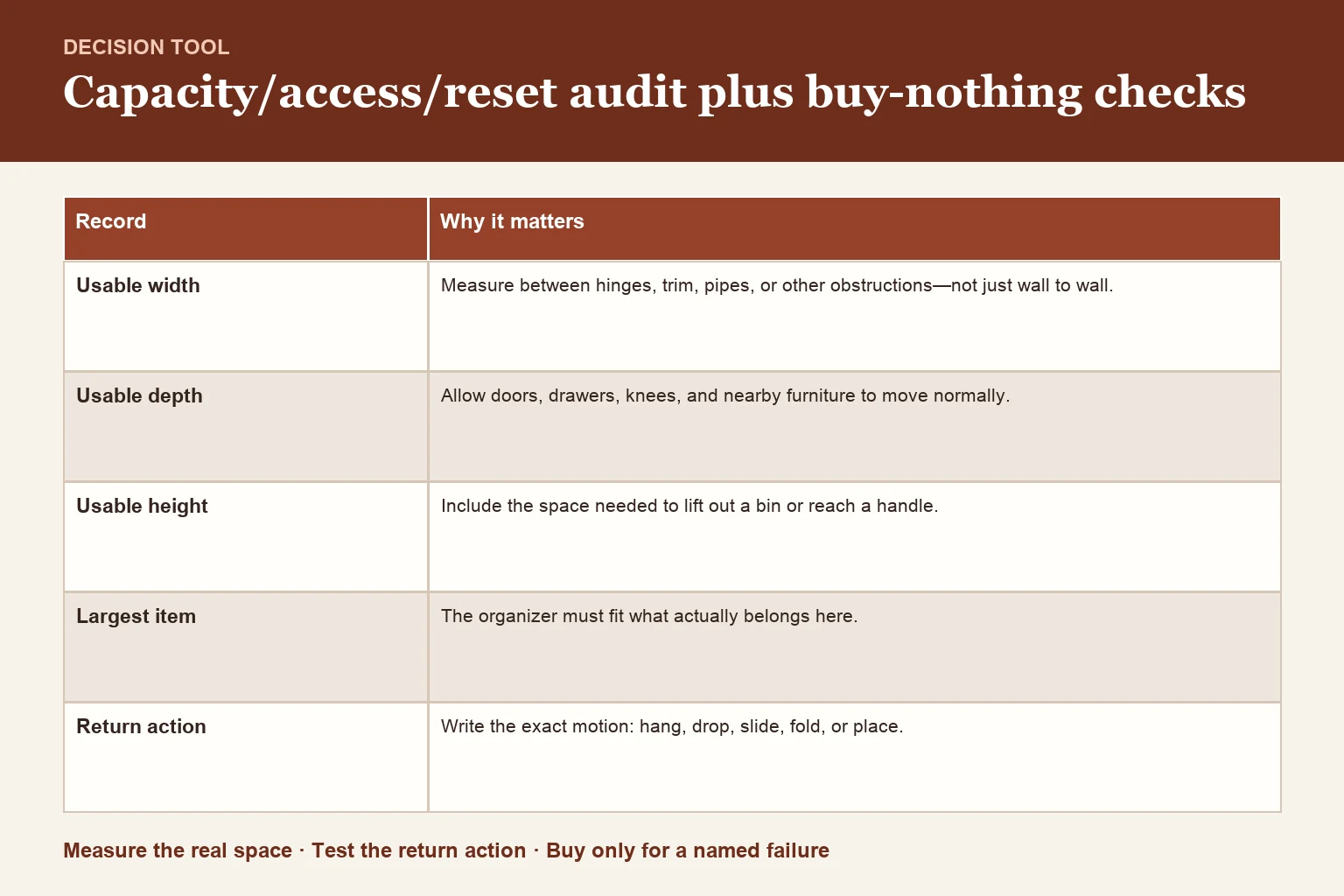
A measure-before-buying worksheet
| Record | Why it matters |
|---|---|
| Usable width | Measure between hinges, trim, pipes, or other obstructions—not just wall to wall. |
| Usable depth | Allow doors, drawers, knees, and nearby furniture to move normally. |
| Usable height | Include the space needed to lift out a bin or reach a handle. |
| Largest item | The organizer must fit what actually belongs here. |
| Return action | Write the exact motion: hang, drop, slide, fold, or place. |
What to do when the apartment still feels full
Do not keep expanding storage one product at a time. Return to a bounded zone and decide which items support current life, which belong elsewhere, and which can leave the home. The one-zone decluttering method gives you a stopping point so the project does not spread across the apartment.
Frequently asked questions
Should I buy matching bins for a small apartment?
Only after the category, measurements, and return action are clear. Matching containers can make a shelf look calmer, but they do not fix excess capacity or poor access.
What should go in hard-to-reach storage?
Lightweight, clearly labeled items used occasionally. Daily items belong in the easiest safe reach.
How much empty storage space should I leave?
There is no universal percentage. Leave enough room that normal arrivals can be put away without rearranging the entire zone.