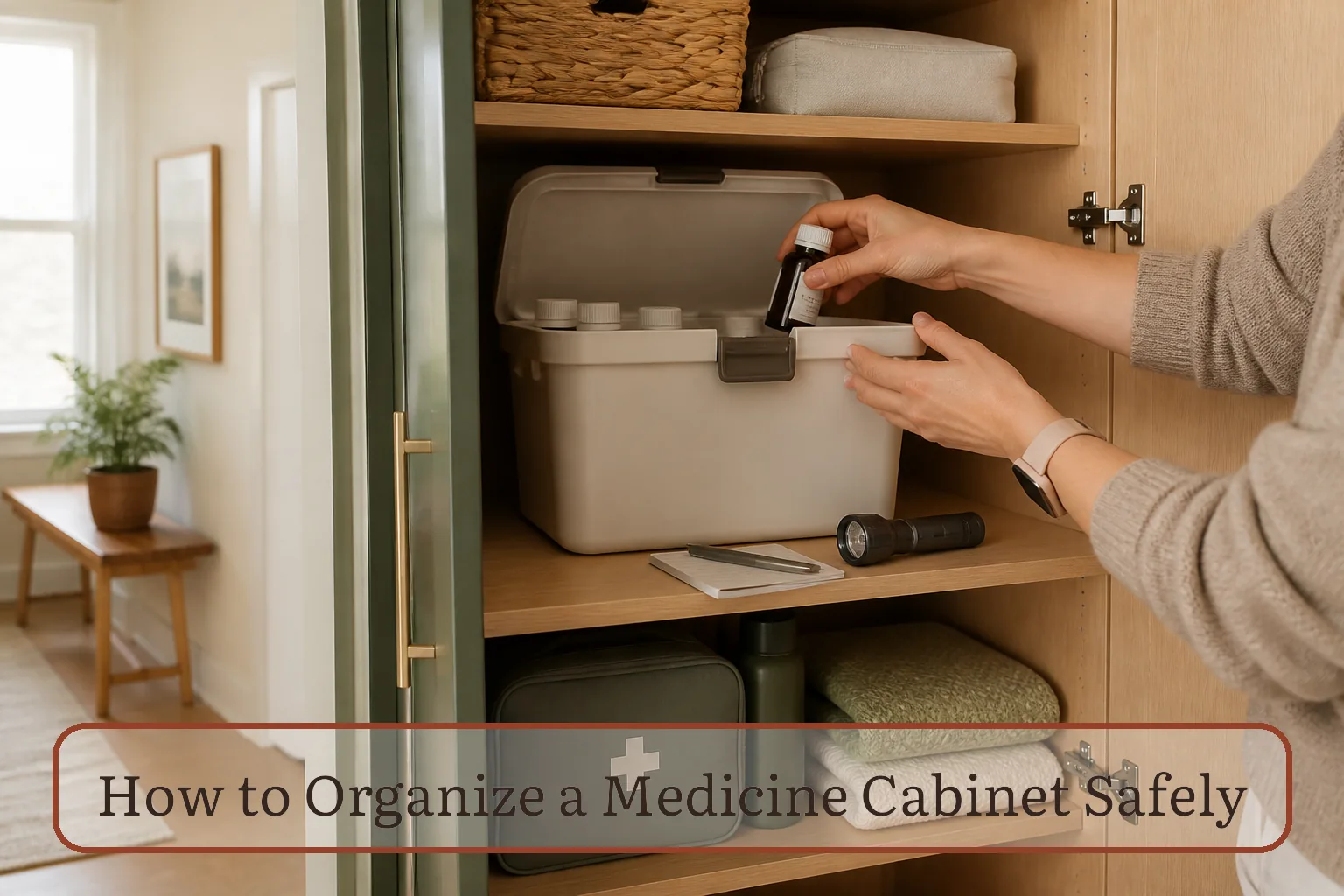
Decide whether medicine belongs in the bathroom at all
The words “medicine cabinet” describe a fixture, not an instruction. FDA consumer guidance says to store medicines in a cool, dry place or as stated on the label and to keep them in their original containers. Heat and humidity from showers can make a bathroom unsuitable for products labeled for dry room-temperature storage. A bedroom closet shelf, locked hall cabinet, or another dry location may be a better choice, provided it meets the label and access requirements.
Do not move a medicine that requires refrigeration into a room-temperature cabinet. Keep it in its original container in a designated refrigerator location that is separated from food spills and inaccessible to children. Ask a pharmacist about any product with an unclear label, a damaged package, a temperature excursion, or special handling instructions.
Label-first storage decision matrix
| The label or situation says | Storage response | Container rule | Who can confirm |
|---|---|---|---|
| Room temperature; protect from moisture or light | Use a dry interior cabinet away from shower steam, sinks, windows, and heat sources | Keep the original bottle, carton, desiccant, and child-resistant closure as supplied | Pharmacist if the home regularly exceeds the stated conditions |
| Refrigerate | Use a stable refrigerator location within the stated temperature range, not the bathroom | Retain the pharmacy label and protective packaging | Pharmacist after freezing, warming, or a power outage |
| Controlled, high-risk, or easily misused medicine | Use locked storage appropriate to the people who live in or visit the home | Do not combine it with another person’s supply | Pharmacist or prescriber for storage and disposal instructions |
| Unclear, missing, damaged, or unreadable label | Separate it from usable medicine; do not guess its identity or dose | Do not relabel it from memory | Dispensing pharmacy or local medicine-disposal program |
| Expired, discontinued, recalled, or no longer wanted | Move it promptly to a secure disposal holding box | Keep it closed and inaccessible until disposal | FDA guidance, pharmacist, or authorized take-back site |
Sort one shelf at a time without creating a mix-up
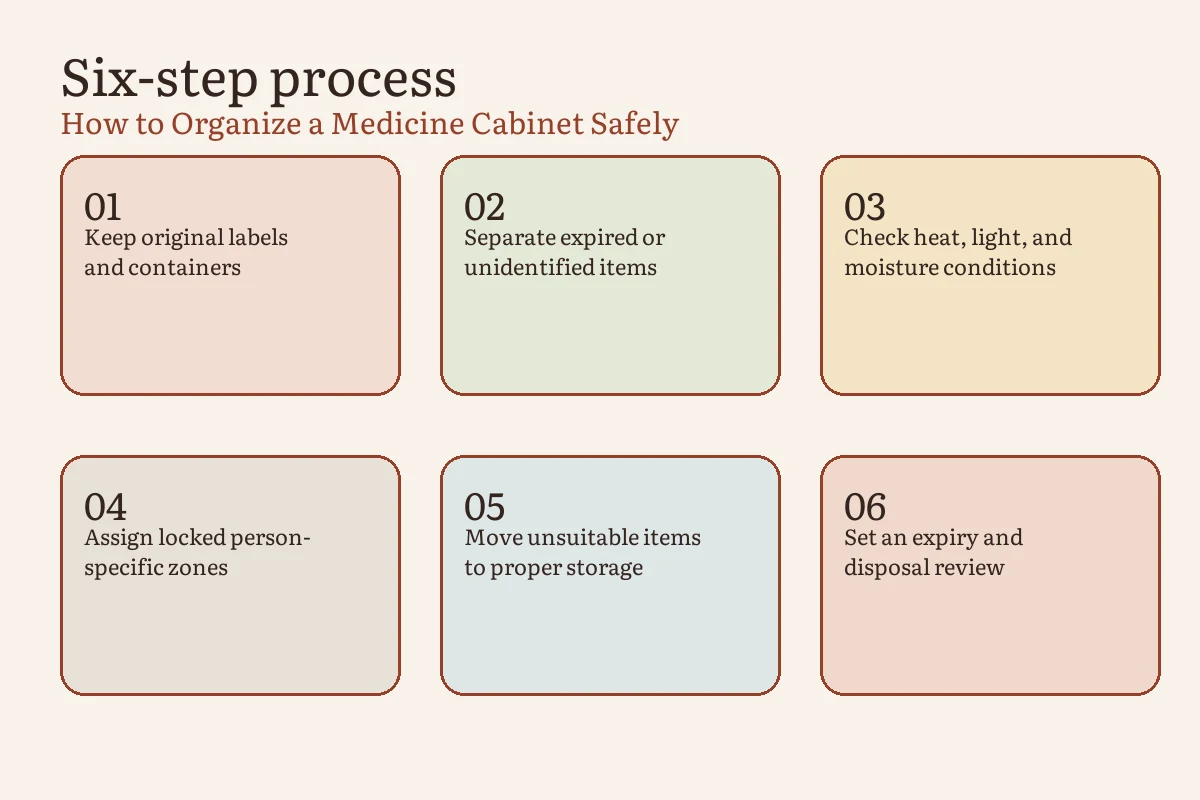
- Set up three controlled destinations. Use one tray for medicines staying in use, one secure box for items awaiting disposal, and one area for non-medicine bathroom products. Keep the disposal box closed and out of reach throughout the project.
- Empty only one shelf or bin. A whole-cabinet dump makes similar bottles easier to confuse. Read each front label and storage instruction before moving to the next item. Do not open packages merely to identify them.
- Separate anything that should not be used. Set aside expired or unwanted medicine, a product with a changed appearance, a container without a readable label, or medicine prescribed to someone who no longer uses it. Do not taste or take an item to identify it.
- Move medicines to compliant storage. Follow the label for room temperature, refrigeration, light, moisture, or other requirements. Put child-resistant caps back on fully after every use. “Up high” alone may not be enough for a child who climbs or a visitor who is at risk; use locked storage when the household situation requires it.
- Create retrieval groups without hiding labels. Separate each person’s prescriptions, current over-the-counter medicines, and first-aid supplies. Use open-front or lift-out bins only if the original labels and expiration dates remain visible. Never use color alone to identify medicine.
- Write an inventory, not dosing instructions. A simple list can record product name, person, expiration date, and storage location. Keep the medical directions on the pharmacy or manufacturer label. Changes to dose, timing, or interactions belong with a pharmacist or prescriber.
- Return the cabinet to a safe default. Close every cap, lock the storage area, and remove the disposal box for prompt take-back. Check bags, purses, nightstands, and countertops too; the best-organized cabinet does not prevent exposure from medicine left elsewhere.
Build zones that support safe use
Within a compliant secure location, organize for recognition rather than appearance. Give each person a clearly labeled section. Place frequently used medicine where the intended adult can retrieve it without moving other bottles, while still protecting it from children and unintended access. Keep measuring syringes, cups, or spoons with the product they came with; a kitchen spoon is not a substitute.
| Zone | Appropriate contents | Boundary that prevents errors |
|---|---|---|
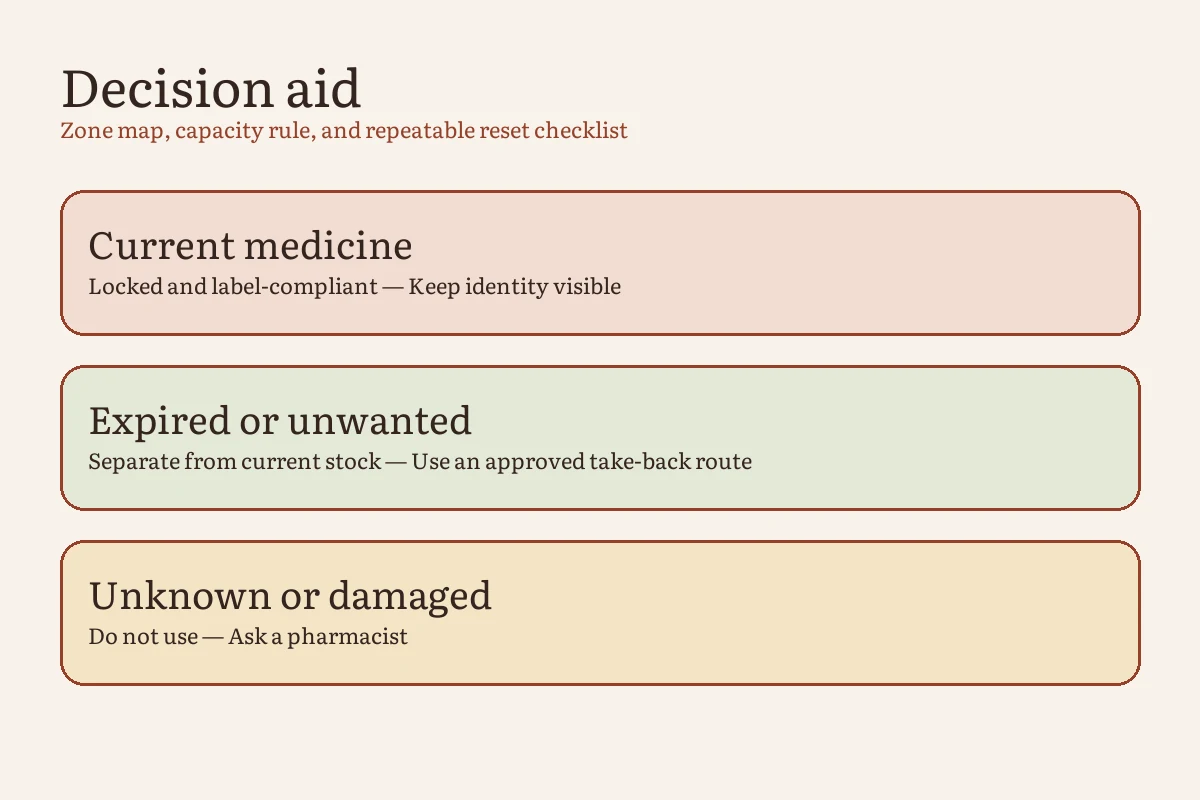
| Current medicine by person | Original containers for medicines currently in use | One named section per person; full labels face forward |
| First-aid supplies | Bandages, gauze, tape, thermometer, and other nonprescription equipment | Separate from daily prescription bottles so supplies do not bury them |
| Refrigerated medicine | Only products whose labels require refrigeration | Dedicated container in a stable, inaccessible spot; never unlabelled |
| Disposal holding | Expired, unwanted, recalled, or unidentified medicine | Closed, marked “do not use,” and kept secure only until prompt disposal |
| Toiletries and cleaners | Personal-care items that are not medicine | Store cleaners separately from food and medicine; never reuse medicine containers |
Use pill organizers with an explicit safety boundary
A weekly organizer may support an established medication routine, but many are not child-resistant. Keep the filled organizer secured just like the original bottles. Retain the original labeled containers so the medicine, directions, lot information, and pharmacy contact remain available. Do not place visually similar pills together unless that is part of a confirmed medication plan.
If you are organizing for someone with memory, vision, dexterity, or complex-medication needs, ask a pharmacist about packaging and reminder options. A tidy layout cannot resolve duplicate therapies, interactions, discontinued prescriptions, or uncertainty about whether a dose was taken.
Dispose of unwanted medicine through the right route
The FDA identifies an authorized drug take-back location or prepaid mail-back envelope as the best option for most unused or expired medicines. Keep the medicine secure while arranging that disposal. Do not leave a take-back bag on the counter or in an unlocked car.
If no take-back or mail-back option is readily available, check the current FDA instructions for that exact medicine. Only a limited set belongs on the FDA flush list; do not flush other medicine by default. FDA also provides household-trash steps for eligible medicines that are not on the flush list. Product-specific instructions and local rules can differ, so use the current official route rather than a handwritten cabinet rule.
Five-point safety check
- Every usable medicine has a readable original label and a fully closed cap.
- Every location matches the temperature, moisture, light, and refrigeration directions.
- Children, visitors, pets, and anyone at risk cannot see or access the storage.
- Discontinued or expired items are secured for prompt, approved disposal.
- A pharmacist—not the organizer—is the next step for identity, stability, dose, or interaction questions.
If someone may have taken the wrong medicine
Do not wait for symptoms or try a home remedy. In the United States, contact Poison Control at poison.org or 1-800-222-1222 for case-specific guidance; call emergency services immediately for collapse, seizure, trouble breathing, or inability to wake. Outside the United States, contact the local poison center or emergency service. Keep the container available so the responder can identify the product, but do not make the person vomit unless a qualified responder instructs you to.
Frequently asked questions
Is the bathroom medicine cabinet safe for any medicine?
Only when the product label permits the actual temperature and humidity conditions and the location prevents unintended access. Many medicines call for cool, dry storage, making another secure interior cabinet a better fit.
Can two family members share one labeled bin?
A shared outer cabinet can work, but give each person a clearly named section and keep every medicine in its original labeled container. Do not combine bottles or rely on cap color, pill shape, or memory.
What should I do with an unidentified loose pill?
Separate it securely and do not take it or return it to a bottle based on appearance. Ask a pharmacist or use an authorized disposal route. If someone may already have swallowed it, contact Poison Control or the local emergency resource promptly.
Sources and editorial method
Every Inch Home created the storage matrix, zone table, and five-point check for this guide. Medicine storage and disposal recommendations were checked against current FDA and Poison Control guidance. This article is an organizing and risk-reduction guide, not individual medical advice.