Write this first: “This counter is mainly for ______.” Prep, coffee, dish landing, and serving are different jobs. A small counter may support more than one, but each needs a boundary.
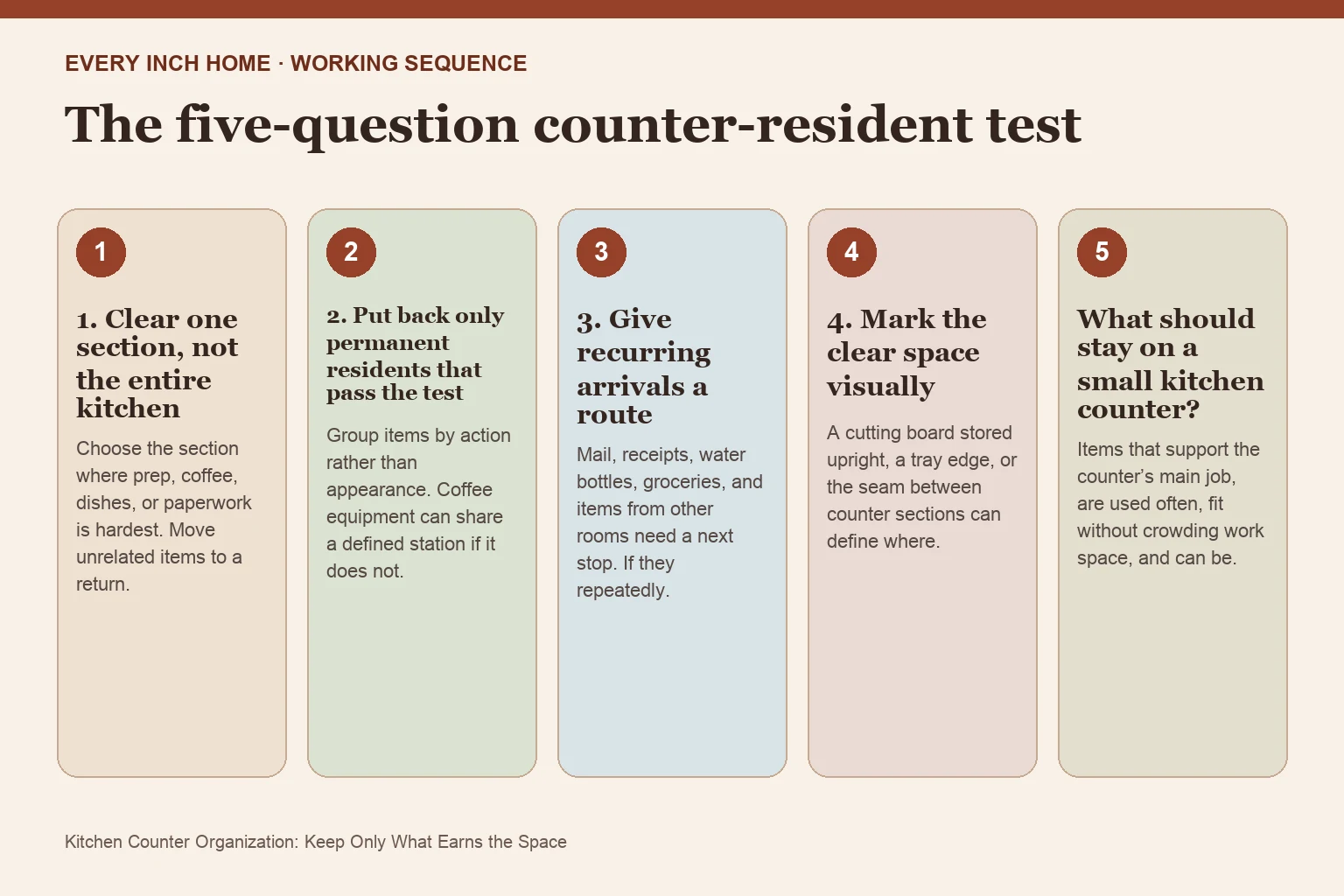
The five-question counter-resident test
Test every appliance, container, utensil crock, bottle, paper pile, and decorative item that usually stays on the counter.
- Is it used at least several times in a normal week? If not, it probably does not need premium access.
- Does it support this counter’s main job? A useful item can still belong in another zone.
- Does it leave enough clear working room? Permanent residents should not force every task onto a tiny remaining corner.
- Can the area around it be cleaned without a major move? A crowded group increases reset steps.
- Can it be returned in a few seconds? If the item constantly migrates, improve its destination or reduce what shares that destination.
Set up the counter in four passes
1. Clear one section, not the entire kitchen
Choose the section where prep, coffee, dishes, or paperwork is hardest. Move unrelated items to a return basket, then clean the exposed surface using a method appropriate for its material.
2. Put back only permanent residents that pass the test
Group items by action rather than appearance. Coffee equipment can share a defined station if it does not remove needed prep room. Cooking oils may belong near the cooking zone if the product and kitchen conditions support that storage.
3. Give recurring arrivals a route
Mail, receipts, water bottles, groceries, and items from other rooms need a next stop. If they repeatedly land on the counter, add a small arrival tray, return basket, recycling route, or scheduled action—but keep that container bounded.
4. Mark the clear space visually
A cutting board stored upright, a tray edge, or the seam between counter sections can define where permanent items stop. The marker is not decoration; it makes drift easier to notice and correct.
A two-minute kitchen close-down
- Return food and tools to their named zones.
- Move dishes to the sink or dishwasher route.
- Empty the small return basket if it is full.
- Wipe the active work section when appropriate.
- Leave tomorrow’s first task with a clear starting surface.
If this takes much longer than two minutes, the problem may be capacity or access rather than discipline. Check whether cabinets are overfilled, the return route requires too many motions, or an item has no destination at all.
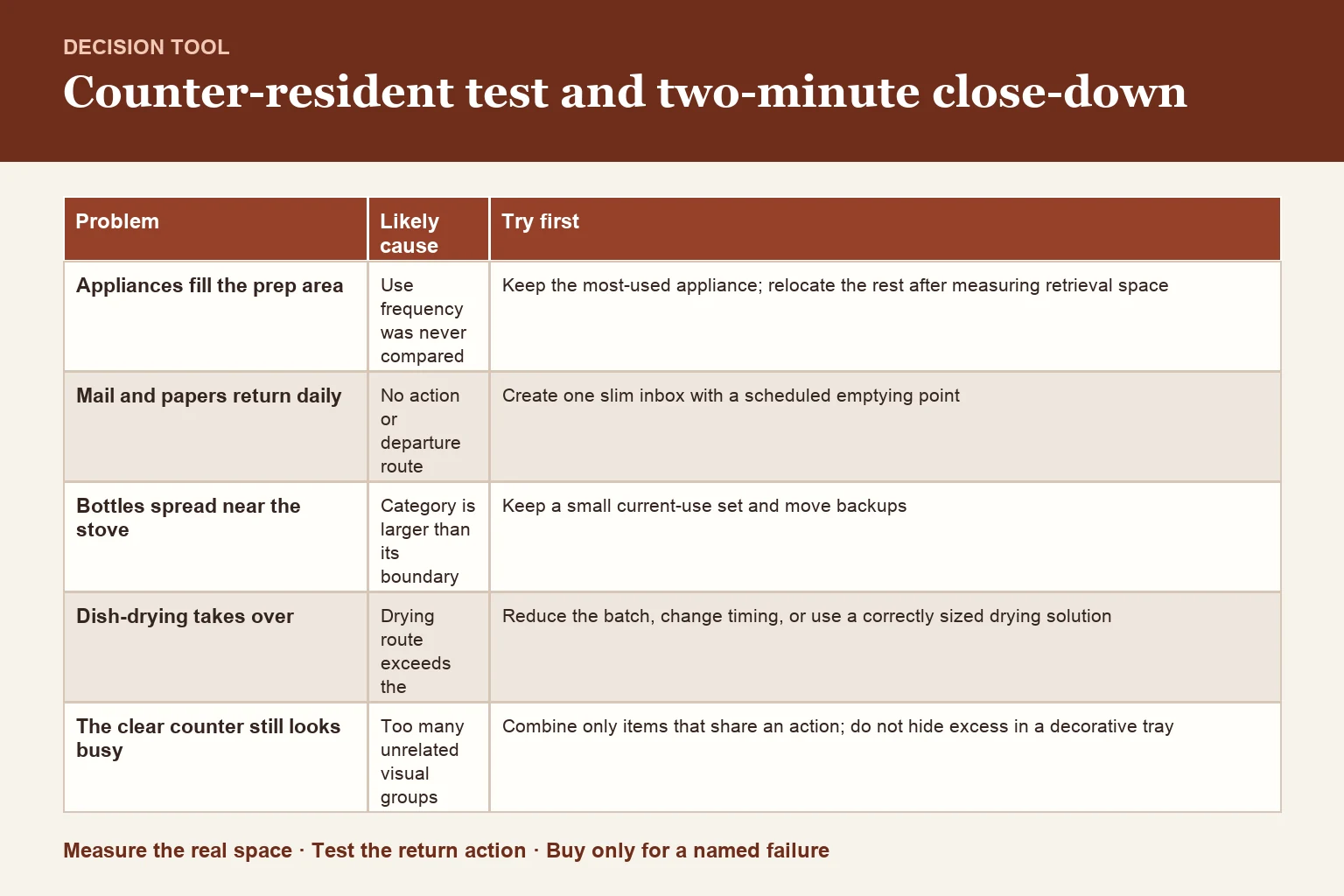
Common counter problems and the better fix
| Problem | Likely cause | Try first |
|---|---|---|
| Appliances fill the prep area | Use frequency was never compared with work-space cost | Keep the most-used appliance; relocate the rest after measuring retrieval space |
| Mail and papers return daily | No action or departure route | Create one slim inbox with a scheduled emptying point |
| Bottles spread near the stove | Category is larger than its boundary | Keep a small current-use set and move backups |
| Dish-drying takes over | Drying route exceeds the available footprint | Reduce the batch, change timing, or use a correctly sized drying solution |
| The clear counter still looks busy | Too many unrelated visual groups | Combine only items that share an action; do not hide excess in a decorative tray |
Frequently asked questions
What should stay on a small kitchen counter?
Items that support the counter’s main job, are used often, fit without crowding work space, and can be reset quickly. The exact group will differ by household.
Do trays make counters look less cluttered?
A tray can define a real station, but it should not legitimize unrelated excess. Give the tray a category and a maximum boundary.
How do I stop papers from collecting in the kitchen?
Create a small named inbox near the true arrival route, then schedule when items are filed, recycled, acted on, or moved. Keep the inbox smaller than the surface it replaces.