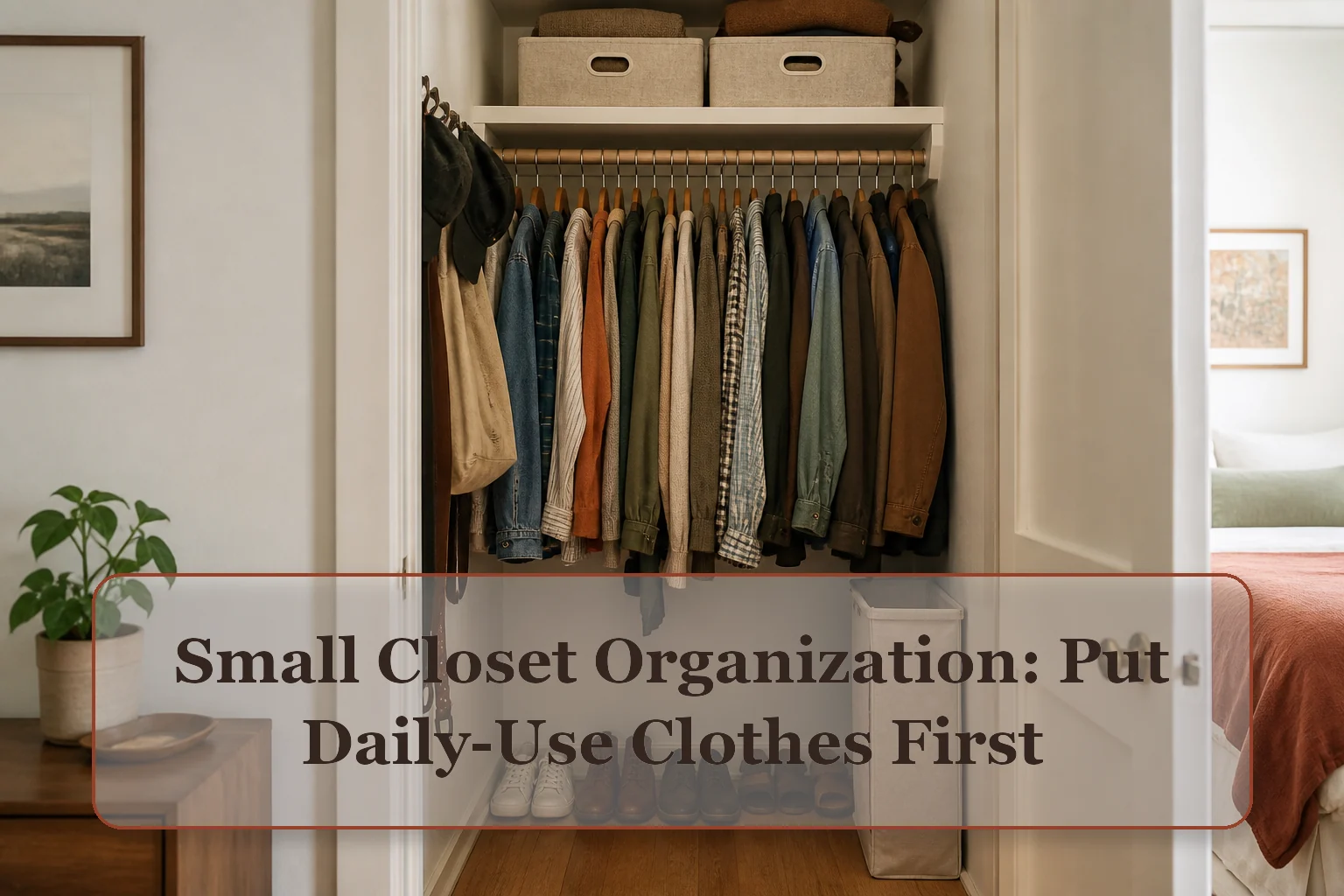
The access map: current week → current season → occasional → archival. The more often an item is used, the fewer motions it should take to reach and return.
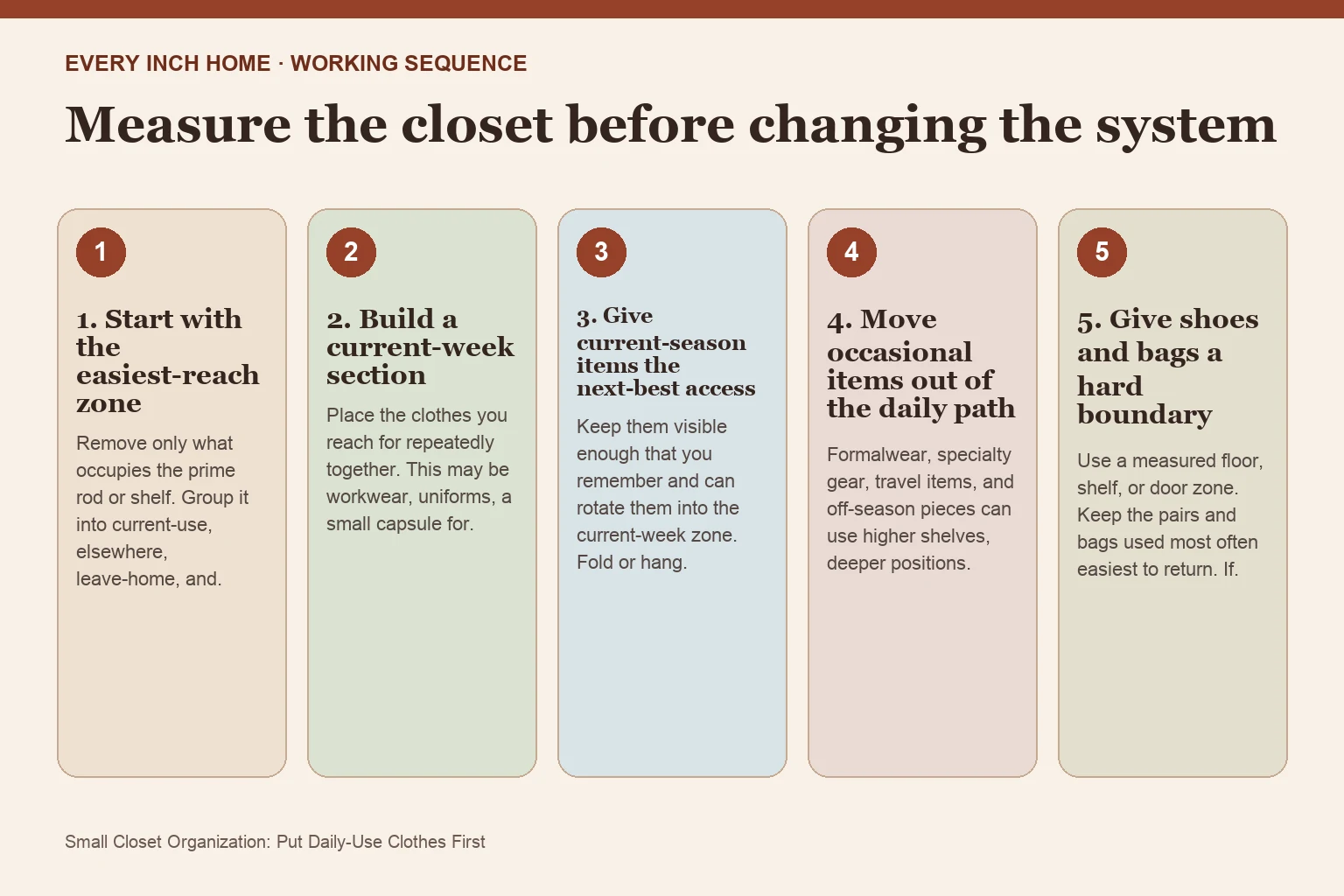
Measure the closet before changing the system
- Measure usable rod width between walls, supports, and door openings.
- Measure shelf width, depth, and lift-out height.
- Measure floor width and depth with the door moving normally.
- Note the reach zones that are comfortable and safe for the people using the closet.
- Record long garments, bulky items, shoe heights, and the largest folded category.
Measurements keep you from buying a system that fits the wall but not the clothes, door, hangers, or return motion.
The small-closet organization method
1. Start with the easiest-reach zone
Remove only what occupies the prime rod or shelf. Group it into current-use, elsewhere, leave-home, and decide-by-deadline. Do not empty every shelf unless you have time to return the entire closet to use.
2. Build a current-week section
Place the clothes you reach for repeatedly together. This may be workwear, uniforms, a small capsule for the current weather, or shared daily accessories. The point is fast use and fast return, not a prescribed wardrobe size.
3. Give current-season items the next-best access
Keep them visible enough that you remember and can rotate them into the current-week zone. Fold or hang based on the garment, available dimensions, and care needs—not on a universal aesthetic rule.
4. Move occasional items out of the daily path
Formalwear, specialty gear, travel items, and off-season pieces can use higher shelves, deeper positions, under-bed storage, or another dry location when appropriate. Label containers on the edge you can see.
5. Give shoes and bags a hard boundary
Use a measured floor, shelf, or door zone. Keep the pairs and bags used most often easiest to return. If the category exceeds the boundary, edit the category rather than covering the walkway with overflow.
6. Create a clear laundry handoff
Dirty, worn-again, clean-but-not-put-away, and repair items are different states. Give each only the route it truly needs. A small hamper, one hook for worn-again clothing, and a scheduled return step can prevent the closet floor from becoming the state system.
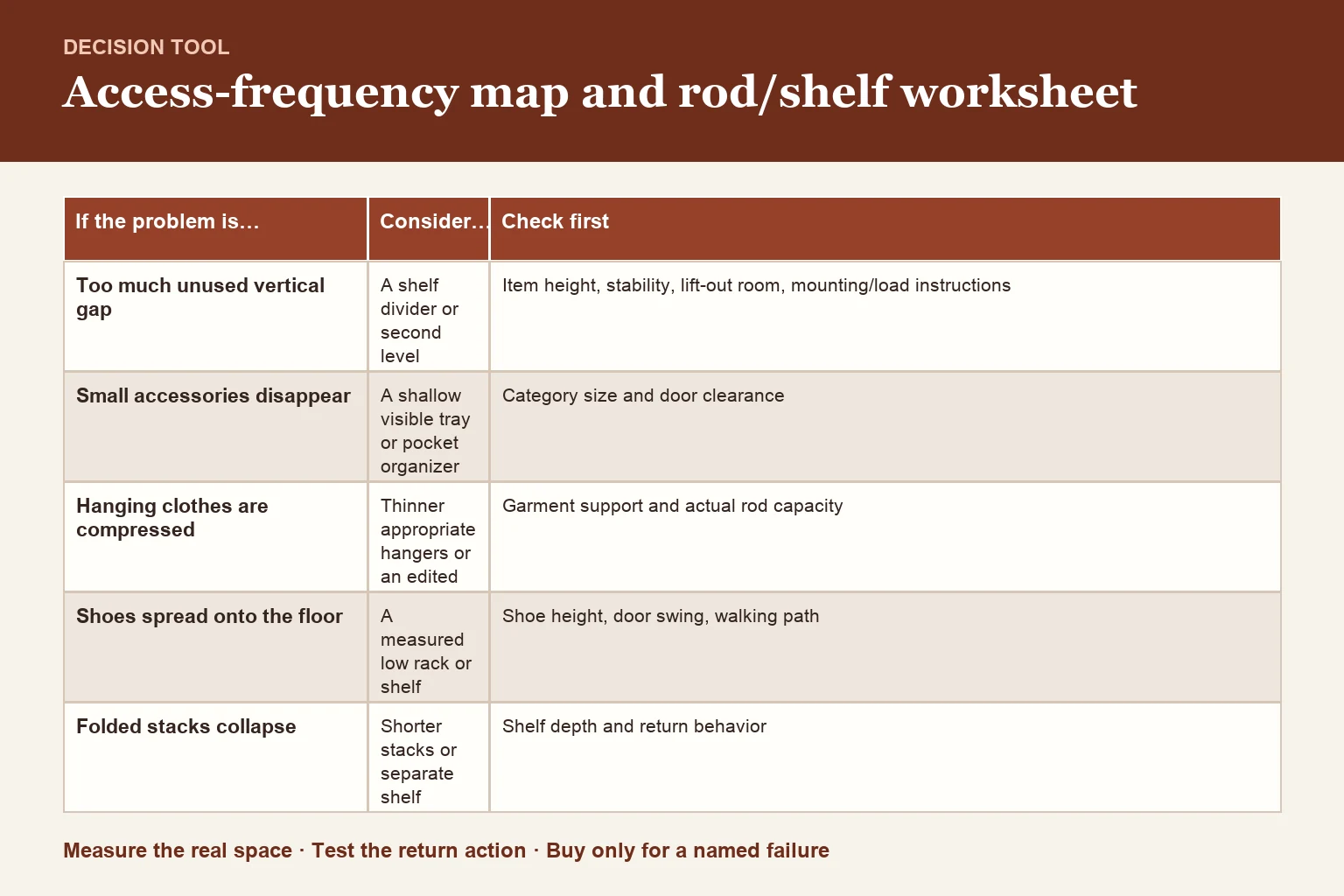
Choose organizers by the motion they improve
| If the problem is… | Consider… | Check first |
|---|---|---|
| Too much unused vertical gap | A shelf divider or second level | Item height, stability, lift-out room, mounting/load instructions |
| Small accessories disappear | A shallow visible tray or pocket organizer | Category size and door clearance |
| Hanging clothes are compressed | Thinner appropriate hangers or an edited rod | Garment support and actual rod capacity |
| Shoes spread onto the floor | A measured low rack or shelf | Shoe height, door swing, walking path |
| Folded stacks collapse | Shorter stacks or separate shelf categories | Shelf depth and return behavior |
A five-minute weekly closet reset
- Return empty hangers to one place.
- Move dirty clothing to the laundry route.
- Return current-week items to the easiest reach.
- Move one unused current-week item back to seasonal storage if needed.
- Clear the floor and close the leaving-home route.
Frequently asked questions
How can I organize a small closet without buying organizers?
Edit one access zone, group by frequency, use existing boxes or trays where they improve a return motion, and move occasional items out of prime space.
Should I organize clothes by color or type?
Use the grouping that makes choosing and returning easiest. Frequency and garment type often affect access more than color, but color can be a helpful secondary cue.
What belongs on the closet floor?
Only categories with a clear boundary that do not obstruct the door or path—often a hamper, a measured shoe zone, or a small leaving-home bag.