Use the tool: Work toward the pair count, depth, ventilation, and route decision; test it with the real items and route before expanding storage.
Count pairs by use and condition
- Daily: Count the pairs used in an ordinary week by every household member. This group deserves the easiest arrival-and-return route.
- Occasional and seasonal: Separate event, sport, work, and weather-specific footwear. Store it by the point of use or season rather than crowding the entry.
- Care needs: Wet, muddy, delicate, leather, and structured shoes need different drying and support. Follow material and manufacturer care guidance.
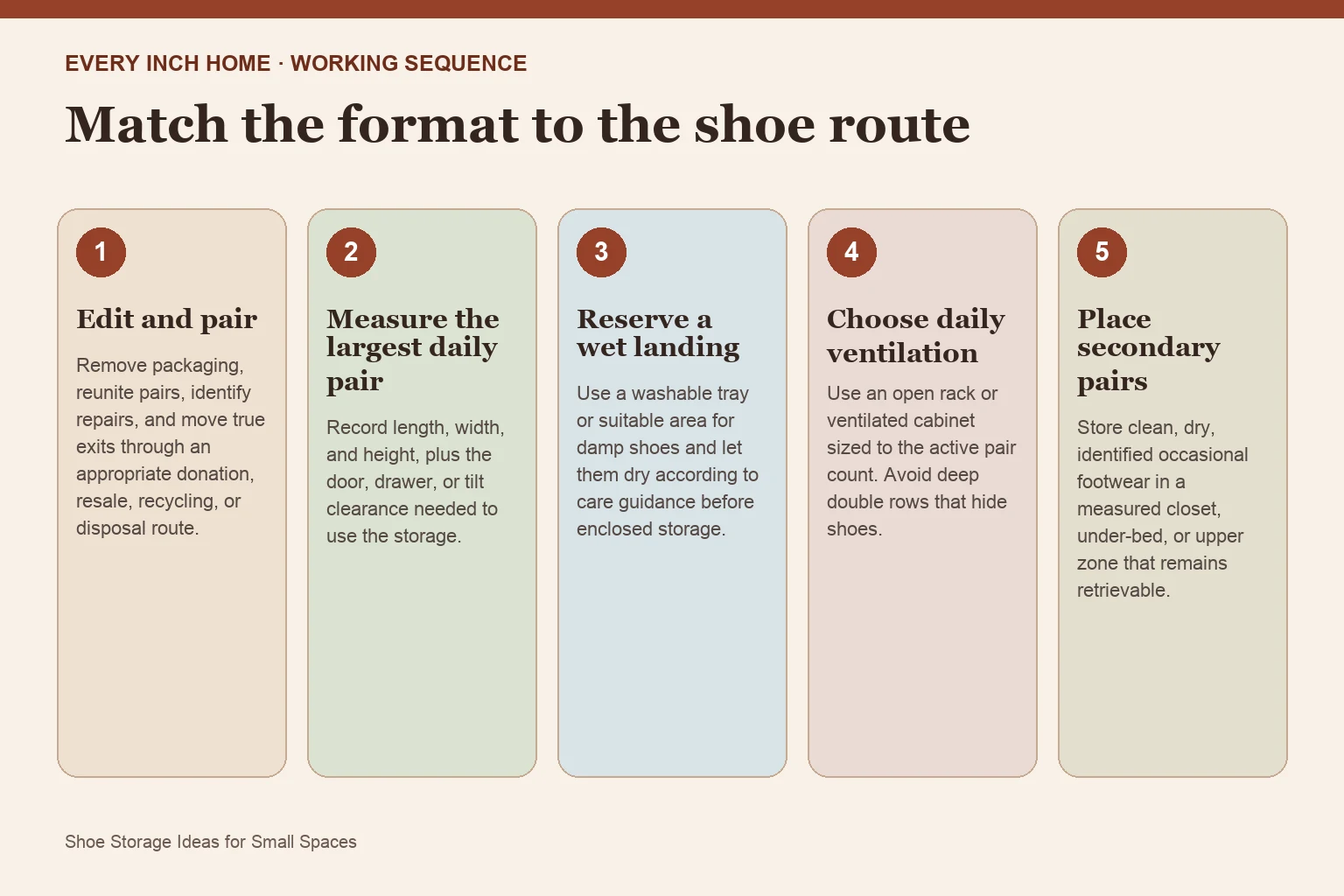
Match the format to the shoe route
1. Edit and pair
Remove packaging, reunite pairs, identify repairs, and move true exits through an appropriate donation, resale, recycling, or disposal route.
2. Measure the largest daily pair
Record length, width, and height, plus the door, drawer, or tilt clearance needed to use the storage.
3. Reserve a wet landing
Use a washable tray or suitable area for damp shoes and let them dry according to care guidance before enclosed storage.
4. Choose daily ventilation
Use an open rack or ventilated cabinet sized to the active pair count. Avoid deep double rows that hide shoes.
5. Place secondary pairs
Store clean, dry, identified occasional footwear in a measured closet, under-bed, or upper zone that remains retrievable.
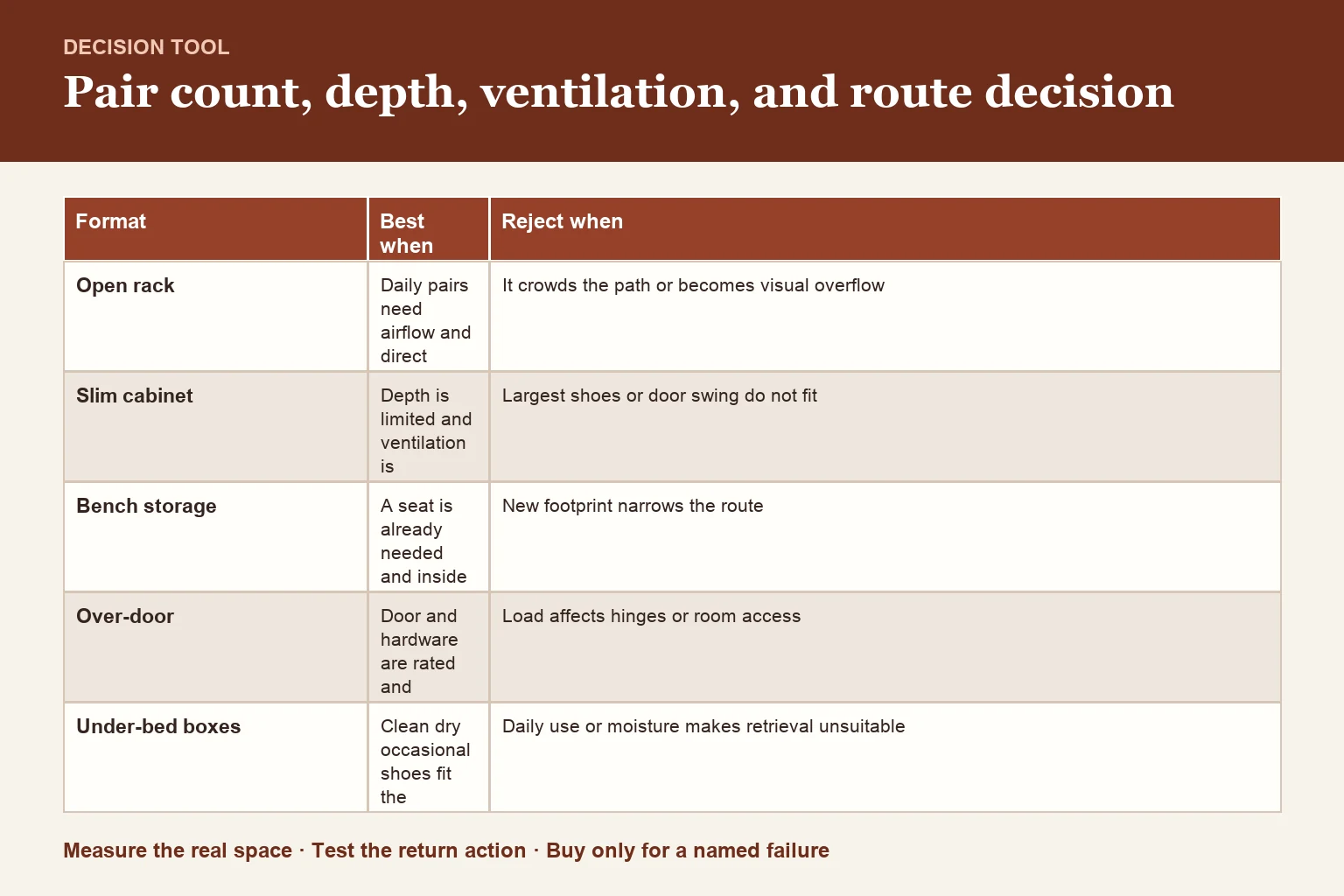
Pair count, depth, ventilation, and route decision
| Format | Best when | Reject when |
|---|---|---|
| Open rack | Daily pairs need airflow and direct return | It crowds the path or becomes visual overflow |
| Slim cabinet | Depth is limited and ventilation is adequate | Largest shoes or door swing do not fit |
| Bench storage | A seat is already needed and inside stays dry | New footprint narrows the route |
| Over-door | Door and hardware are rated and closure is clear | Load affects hinges or room access |
| Under-bed boxes | Clean dry occasional shoes fit the environment | Daily use or moisture makes retrieval unsuitable |
Measure usable depth, not product depth alone
Add the shoe toe or heel overhang, hand clearance, cabinet door or tilt movement, baseboard gap, and the walking space required in front. Verify weight rating, anchoring or anti-tip instructions, ventilation, and shelf dimensions. A slim cabinet that makes the hallway narrower while open may not fit the route.
Use a daily-pair limit at the door
Assign each person a small current-pair boundary. Return dry shoes to it, move wet pairs through the drying route, and carry occasion shoes back after use. At seasonal change, inspect condition and rotate the entry rather than adding another row to the daily zone.
Frequently asked questions
What is the best shoe storage for a small space?
Choose from your pair count, largest shoe dimensions, ventilation needs, and route clearance. A low open rack or correctly fitted slim cabinet often serves daily pairs.
Can shoes be stored under the bed?
Clean, dry occasional shoes can be stored there when the environment, container, clearance, and material care are suitable; daily wet shoes should not.
How many shoes should stay by the door?
Keep the few pairs each person uses in the current week or weather within a defined boundary; store the rest by season or purpose.