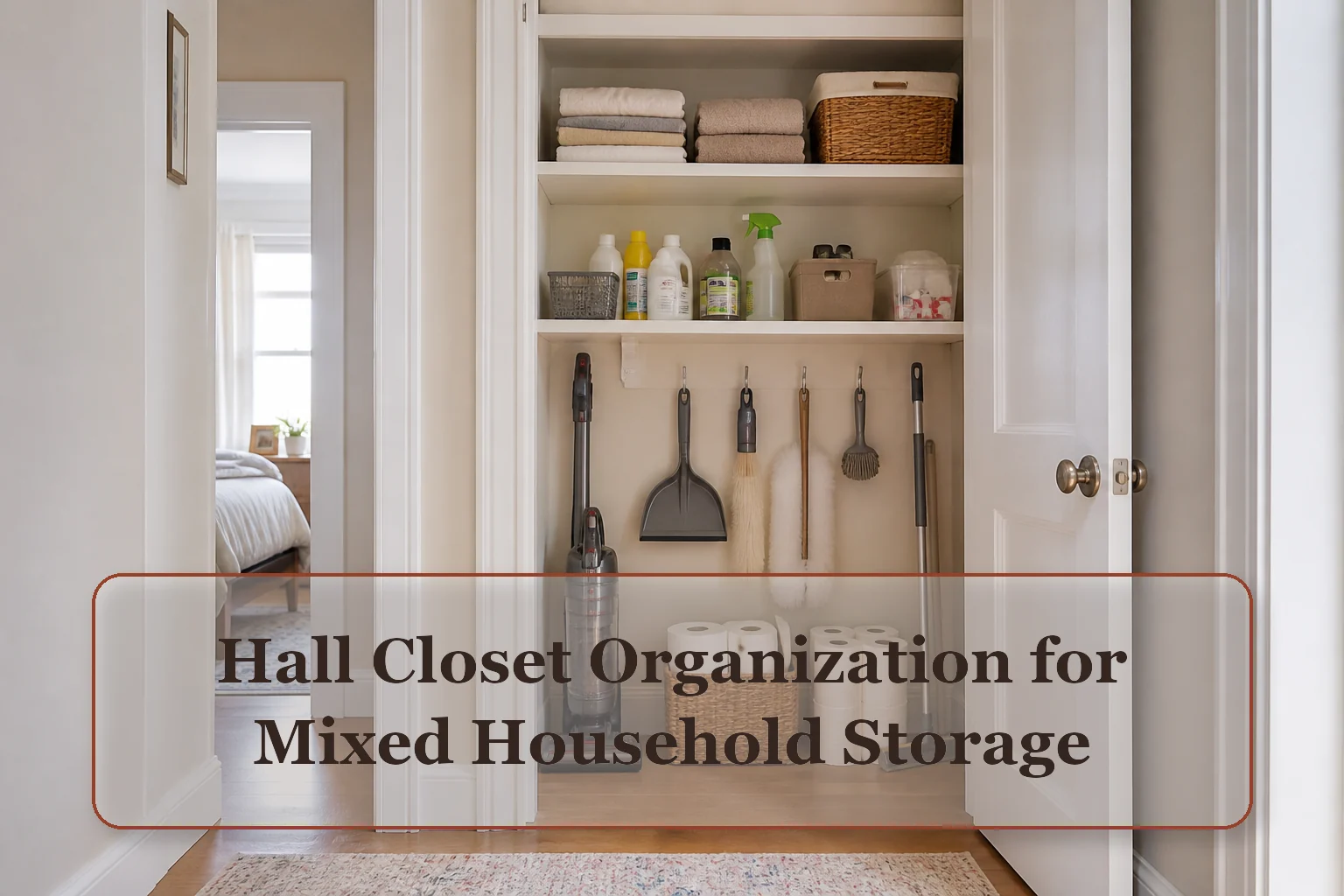
Use the tool: Work toward the mixed-category capacity map; test it with the real items and route before expanding storage.
Write the closet's one-sentence job
- Accepted functions: Choose two or three compatible functions, not every homeless item in the house. For example: cleaning tools, household backstock, and guest linens.
- Largest object: Measure and park the vacuum, folding chair, or other largest approved item first. Smaller storage must work around its real movement path.
- Safety and separation: Keep products in labeled original containers, observe their storage directions, and separate items that should not share a zone with linens, food, pets, or children.
Build the closet around its primary tool
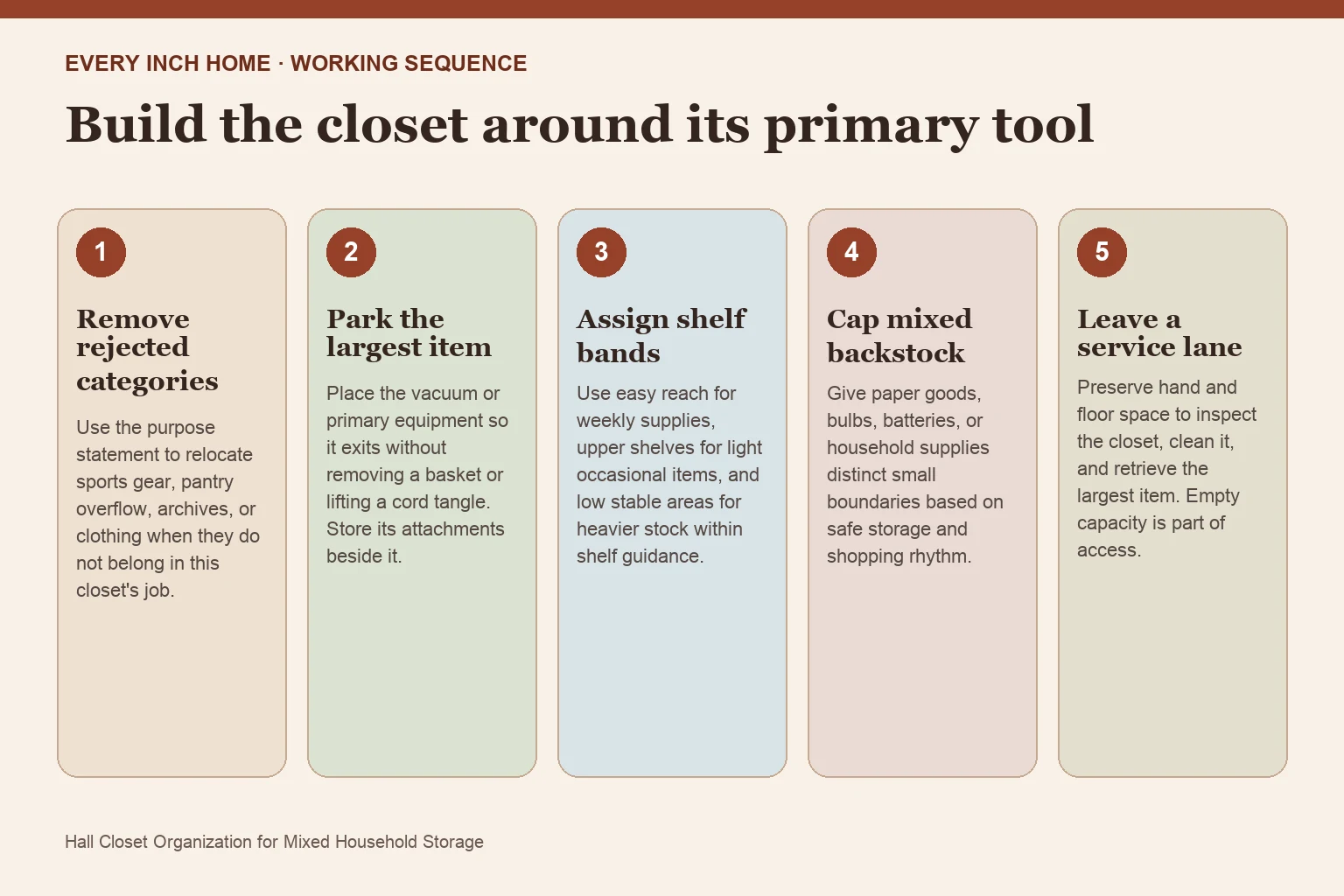
1. Remove rejected categories
Use the purpose statement to relocate sports gear, pantry overflow, archives, or clothing when they do not belong in this closet's job.
2. Park the largest item
Place the vacuum or primary equipment so it exits without removing a basket or lifting a cord tangle. Store its attachments beside it.
3. Assign shelf bands
Use easy reach for weekly supplies, upper shelves for light occasional items, and low stable areas for heavier stock within shelf guidance.
4. Cap mixed backstock
Give paper goods, bulbs, batteries, or household supplies distinct small boundaries based on safe storage and shopping rhythm.
5. Leave a service lane
Preserve hand and floor space to inspect the closet, clean it, and retrieve the largest item. Empty capacity is part of access.
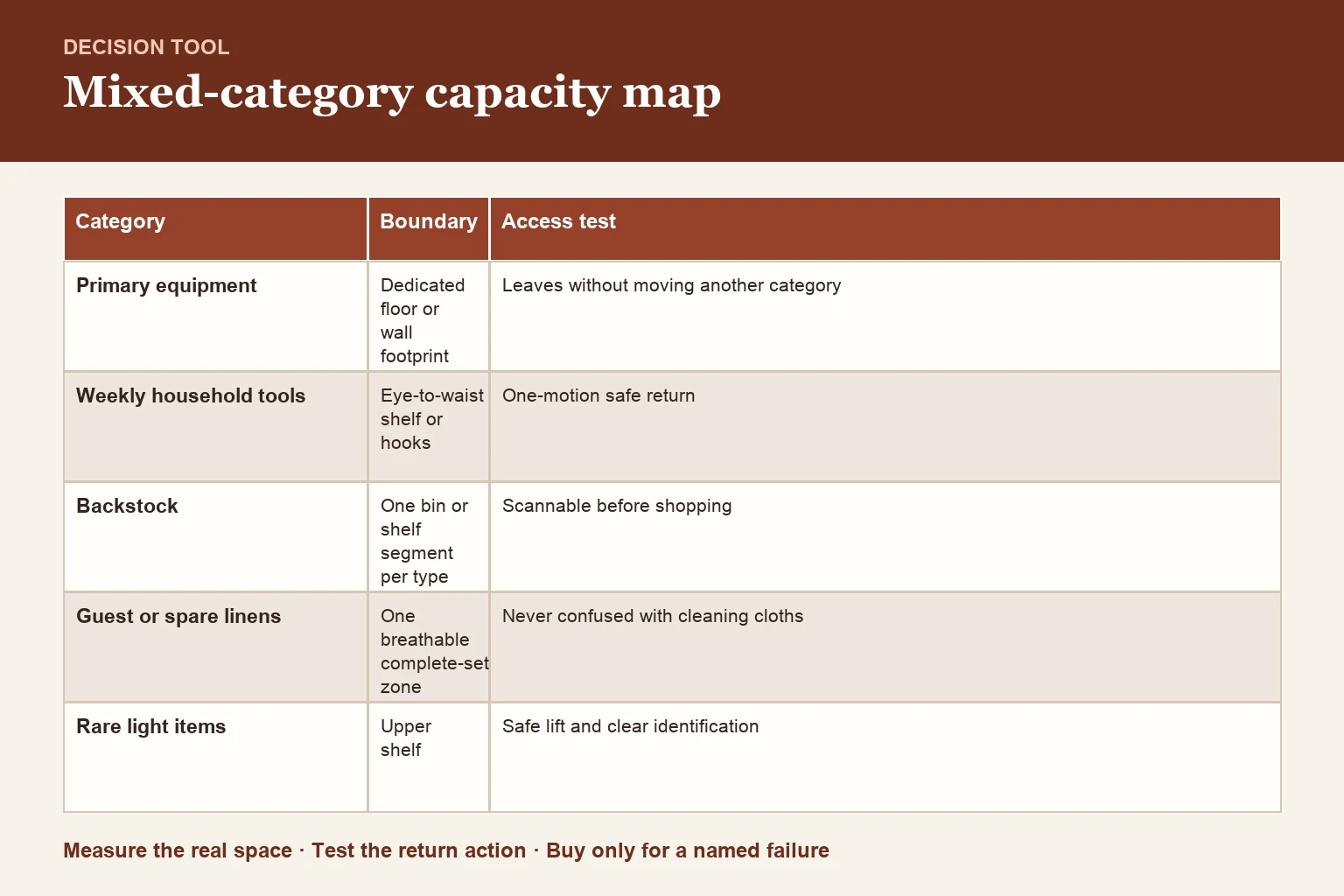
Mixed-category capacity map
| Category | Boundary | Access test |
|---|---|---|
| Primary equipment | Dedicated floor or wall footprint | Leaves without moving another category |
| Weekly household tools | Eye-to-waist shelf or hooks | One-motion safe return |
| Backstock | One bin or shelf segment per type | Scannable before shopping |
| Guest or spare linens | One breathable complete-set zone | Never confused with cleaning cloths |
| Rare light items | Upper shelf | Safe lift and clear identification |
The closet is full when access fails
Do not define fullness by whether one more package physically fits. The capacity limit is reached when the primary tool cannot exit directly, a shelf group must be unloaded, a product label cannot be seen, or inspection and cleaning become difficult. Reduce stock or move a category before installing another layer.
Use an open-door quarterly audit
Remove the primary equipment, inspect the floor and shelves, check product condition and dates where relevant, reunite attachments, count backstock, and verify that the purpose statement is still accurate. Items without a category boundary leave the closet during the audit instead of forming a new miscellaneous zone.
Frequently asked questions
How do I organize a hall closet with many uses?
Limit it to a few compatible functions, park the largest approved object first, and give every other category a measured boundary.
What should go on a hall closet floor?
Use it for the largest stable item and perhaps one low, appropriate category, while preserving a clear retrieval and inspection lane.
How do I stop a hall closet becoming miscellaneous storage?
Post or record its purpose statement and require each accepted category to have a fixed boundary. Relocate anything that cannot pass both tests.