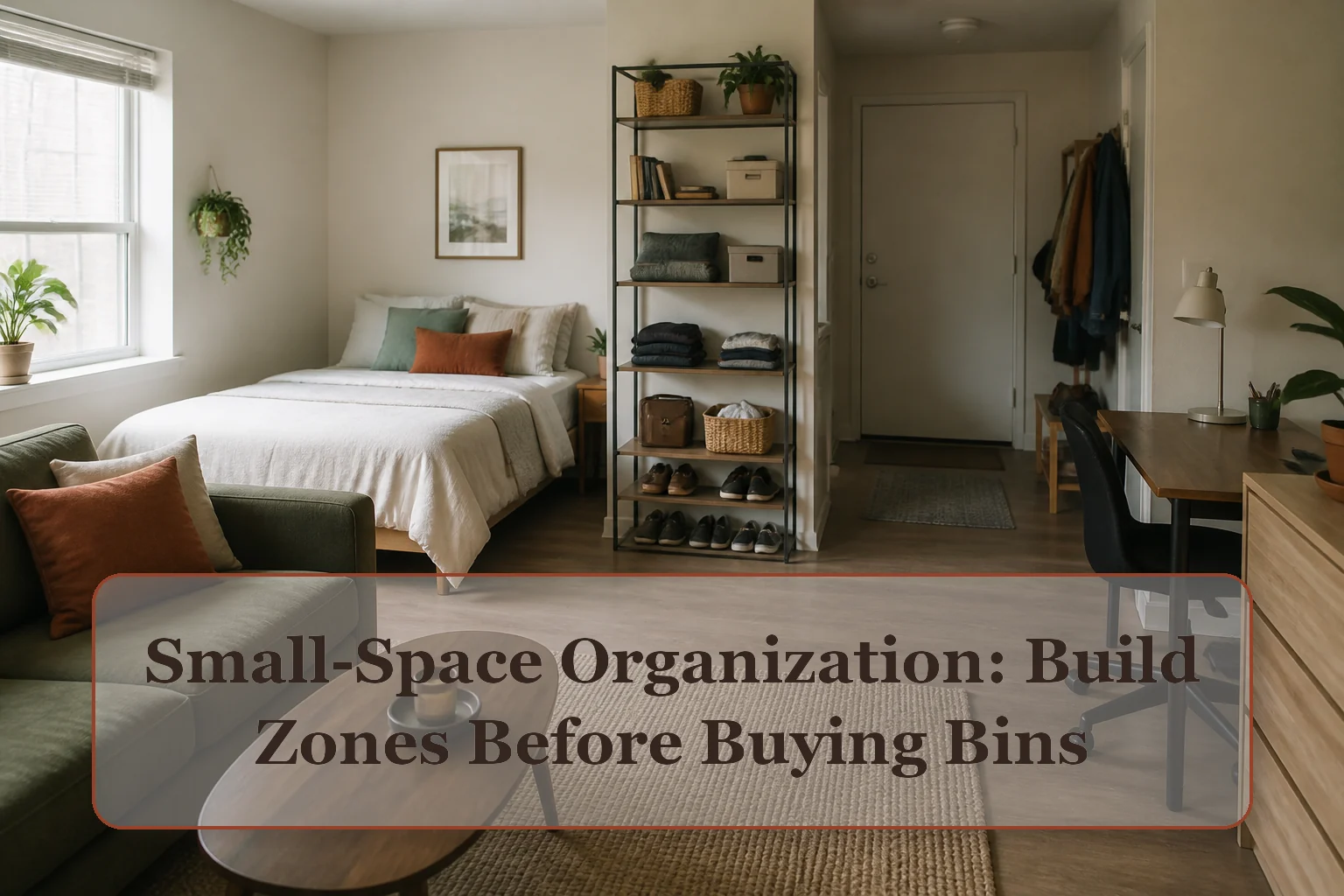
Use the tool: Work toward the buy-nothing diagnostic; test it with the real items and route before expanding storage.
Draw a five-minute map of the home
- Mark fixed constraints: Sketch doors, windows, heaters, vents, outlets, and cabinet swings. These are nonnegotiable spaces, not empty corners waiting for storage.
- Trace three real routes: Draw how you enter and leave, prepare food, and move from laundry to dressed. Repeated backtracking usually reveals a misplaced category.
- Circle natural landings: Keys, mail, clothes, bags, and dishes already land somewhere. Decide whether to support that location or deliberately move it; do not pretend the habit does not exist.
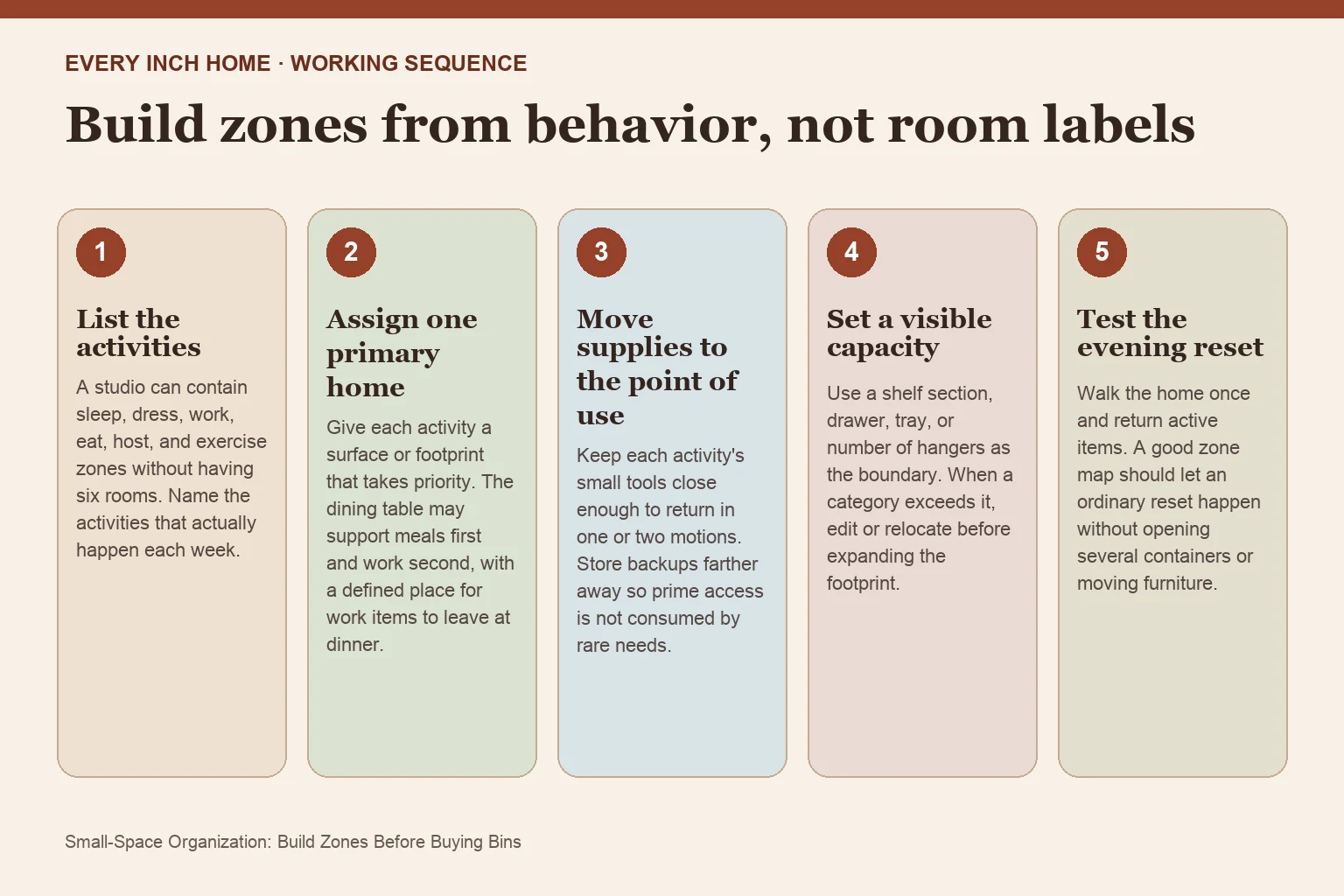
Build zones from behavior, not room labels
1. List the activities
A studio can contain sleep, dress, work, eat, host, and exercise zones without having six rooms. Name the activities that actually happen each week.
2. Assign one primary home
Give each activity a surface or footprint that takes priority. The dining table may support meals first and work second, with a defined place for work items to leave at dinner.
3. Move supplies to the point of use
Keep each activity's small tools close enough to return in one or two motions. Store backups farther away so prime access is not consumed by rare needs.
4. Set a visible capacity
Use a shelf section, drawer, tray, or number of hangers as the boundary. When a category exceeds it, edit or relocate before expanding the footprint.
5. Test the evening reset
Walk the home once and return active items. A good zone map should let an ordinary reset happen without opening several containers or moving furniture.
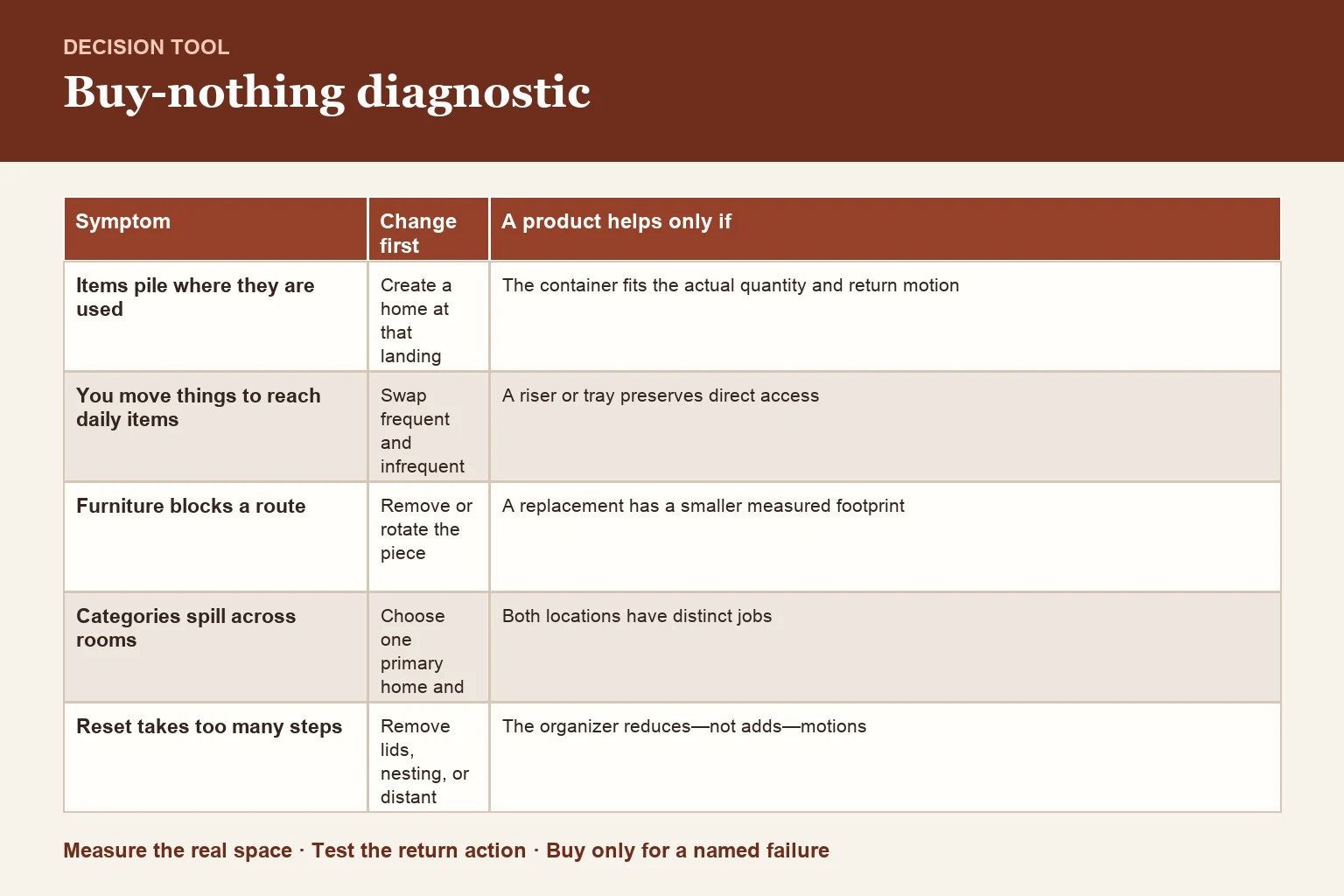
Buy-nothing diagnostic
| Symptom | Change first | A product helps only if |
|---|---|---|
| Items pile where they are used | Create a home at that landing point | The container fits the actual quantity and return motion |
| You move things to reach daily items | Swap frequent and infrequent placement | A riser or tray preserves direct access |
| Furniture blocks a route | Remove or rotate the piece | A replacement has a smaller measured footprint |
| Categories spill across rooms | Choose one primary home and one capped satellite | Both locations have distinct jobs |
| Reset takes too many steps | Remove lids, nesting, or distant returns | The organizer reduces—not adds—motions |
What earns a container in a small home
A container earns space when it holds one named category, fits the zone’s usable dimensions, remains easy to retrieve, and makes the return action simpler. Do not buy to hide an unresolved mixture. Use temporary shoeboxes or painter’s tape for a week; if the zone works, the test gives you the exact size and format worth buying.
Recheck zones after a normal week
Do not judge the setup immediately after organizing. After seven ordinary days, note where items still land, which doors or drawers are annoying, and which categories exceed their boundary. Adjust the zone to the evidence. A useful small space may look active during the day, but it should recover without a major sorting session.
Frequently asked questions
How do I organize a very small home with no storage?
Prioritize clear routes and point-of-use homes, then use existing vertical or under-furniture space only when access remains safe. Editing quantity usually comes before adding furniture.
Should every item have a home?
Every repeat-use category needs a clear boundary and return action. A few flexible landing spaces are useful, but they should be intentionally small and reset regularly.
How can I test an organization idea before buying it?
Mock up the footprint with tape or a plain box, load the real category, and use it for a week. Check clearance, retrieval, and whether the return action is shorter.