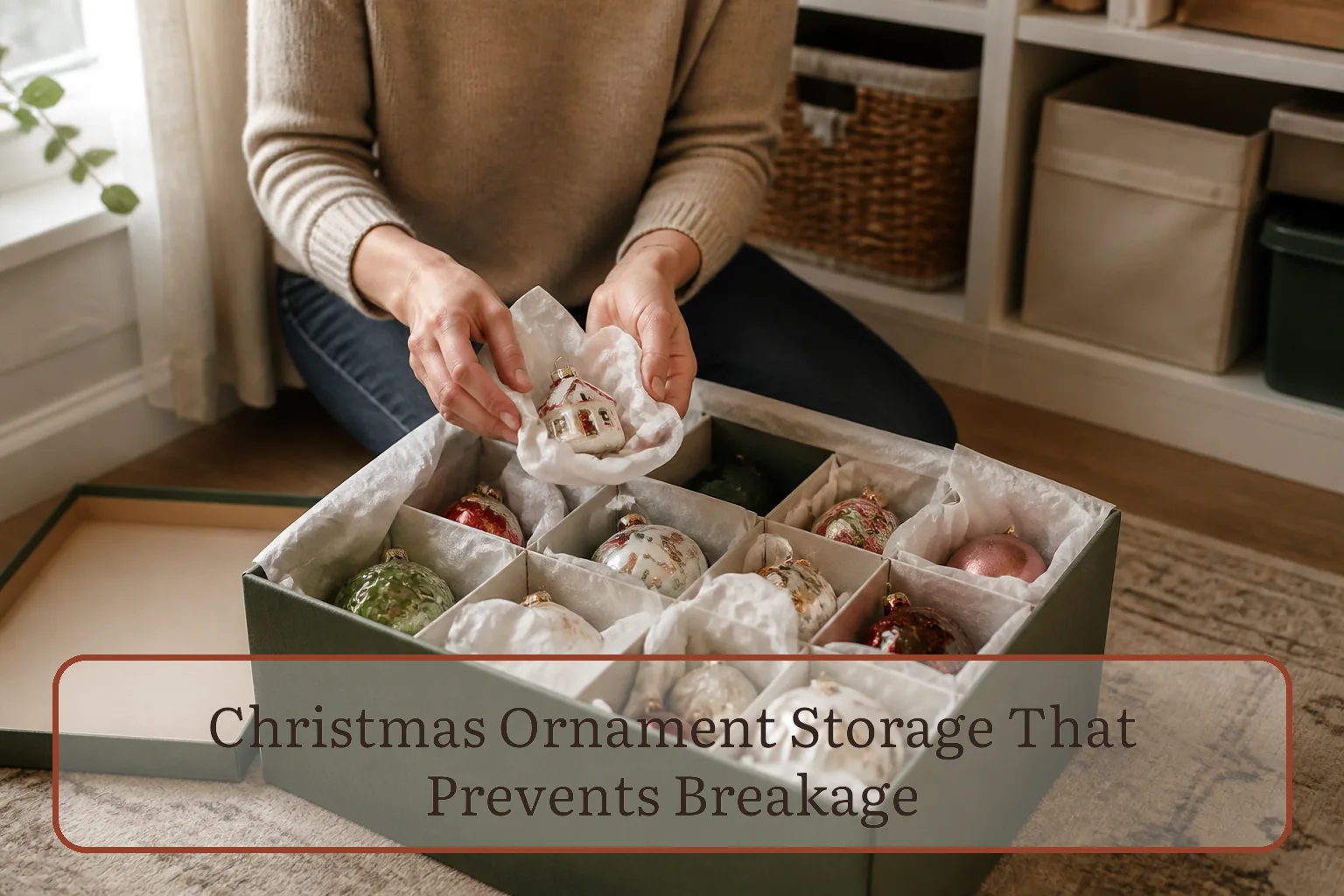
Inspect before wrapping
Prepare a stable table with good light and a soft clean work surface. Handle one ornament at a time, with a clear place ready before lifting it. National Park Service handling guidance for collection objects emphasizes a clear path, supporting fragile items from below, and avoiding more than one object at a time. Those habits are useful for heirloom holiday pieces too.
Look for a loose cap, cracked glass, flaking paint, unstable glitter, detached wire, leaking battery, damp textile, pest evidence, or sticky plastic. Do not wrap active damage tightly and hope the box contains it. Remove batteries from battery-operated decorations when the product instructions call for it, keep the product identity with the item, and isolate leaking or corroded components for appropriate disposal or repair.
The ornament risk-and-housing matrix
| Ornament condition | Primary risk | Housing approach | Keep separate from |
|---|---|---|---|
| Thin glass ball or blown-glass shape | Impact, point pressure, and a weak neck | Individual rigid cell with soft compatible cushioning around the body; cap faces up when practical | Heavy ornaments and loose hooks |
| Irregular figure with projecting parts | Snapped arm, wing, tail, branch, or hanger | Custom cavity wider than the projection; support the main body so the projection carries no load | Flat dividers that press against the fragile feature |
| Painted, gilded, glittered, or flocked surface | Abrasion and finish transfer | Original sound packaging or a non-contact cavity; test any tissue against the care guidance | Rough paper, adhesive, and rubbing surfaces |
| Wood, textile, straw, or paper ornament | Crushing, moisture, pests, and dye transfer | Dry individual support in a material appropriate to the object | Damp items, leaking batteries, and sharp hooks |
| Metal ornament or bell | Scratching, tarnish, and damage to lighter pieces | Separate wrap or cell in a lower layer | Delicate glass and unsupported painted finishes |
| Valuable, antique, or already unstable item | Loss of original material or repair evidence | Photograph, isolate, and seek object-specific conservation advice | Generic tape, glue, aggressive cleaning, and crowded seasonal storage |
Calculate a cell from the ornament, not the tote label
Measure the ornament’s widest body, deepest projection, and full height including a cap that must not be compressed. The usable cell needs clearance for a thin protective layer and finger access, while preventing enough movement for neighboring pieces to collide. Test with an inexpensive sturdy ornament before placing a fragile one.
For a divider grid, measure the box’s internal width and length after accounting for wall thickness. Divide those dimensions by the required cell width and depth, then round down. A nominal “64-ornament” box may be inappropriate for large, irregular, or heirloom pieces. The honest capacity is the number of compatible cavities, not the number printed on the carton.
| Fit test | Pass condition | Adjustment when it fails |
|---|---|---|
| Body support | The strongest main body rests evenly without a hard pressure point | Reshape the cavity or add a compatible soft cradle |
| Projection clearance | Wings, tails, hooks, flowers, and caps do not touch the wall or lid | Use a larger cell or a single-object box |
| Movement test | A gentle level shift does not let the object strike a divider | Fill voids around the supported body without compressing the finish |
| Layer test | The tray or lid closes without contacting the tallest point | Reduce the layer count or use a deeper rigid container |
| Lift test | The closed tote can be lifted level and controlled by the intended user | Split the collection into smaller containers and keep heavy pieces low |
| Return test | The labeled location identifies the exact cavity after decorating | Add a photo map or numbered inventory before storage |
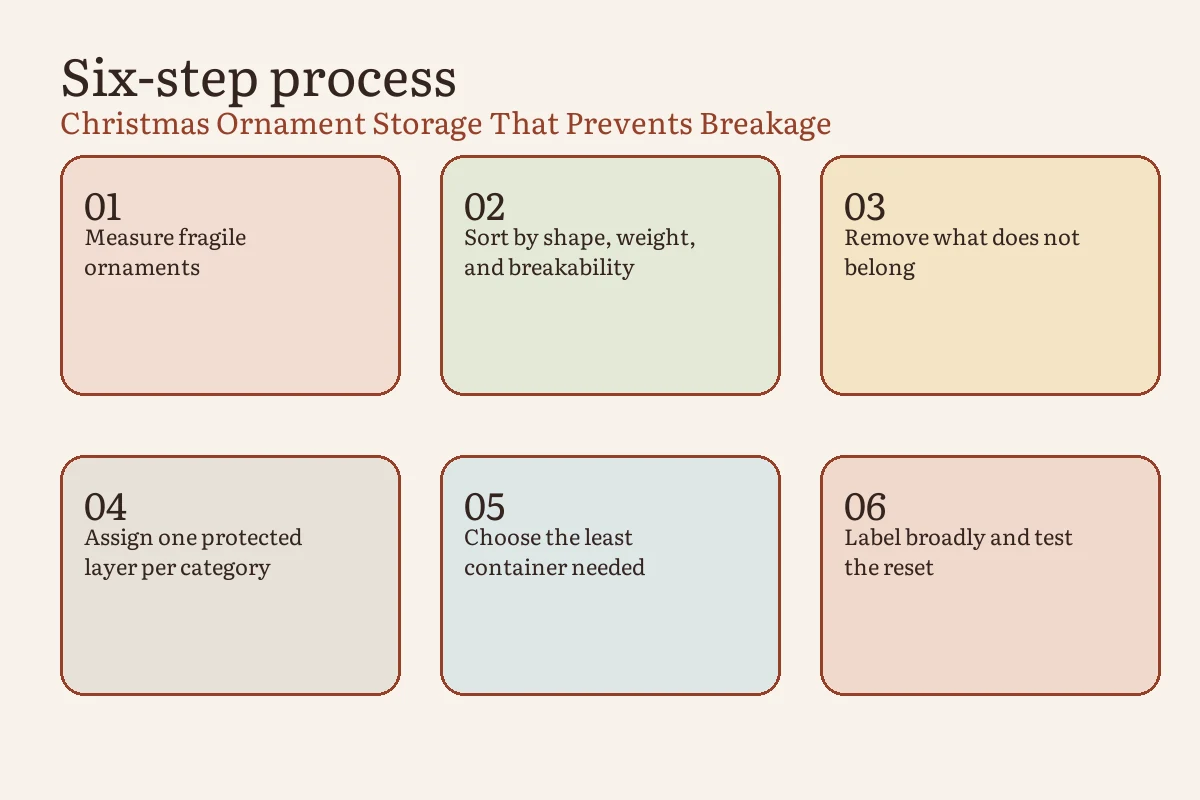
Pack one stable layer at a time
- Match pieces by housing need. Separate thin glass, irregular projections, surface-sensitive finishes, heavy metal, textile or paper, and sturdy replaceable ornaments. Do not group only by color or tree location.
- Prepare rigid boundaries. Assemble dividers so they cannot collapse sideways. Line the tray only with a clean material known to be compatible with the ornament. Avoid newspaper ink, rubber bands, tape on the object, and unknown foam that is crumbling or sticky.
- Support the strongest body area. Lift with two hands when needed and lower the ornament into its cell. Do not carry it by the hanging cap, loop, ribbon, wire, or glued decoration.
- Immobilize without compression. Fill open space around the supported body. Stop if the cushioning pushes on a fragile projection or rubs a powdery, gilded, painted, flocked, or glittered surface.
- Keep weight low and separated. Put heavy, sturdy ornaments in the bottom tray or their own small box. Do not place a loaded tray directly on unprotected glass below.
- Photograph each finished layer. A quick overhead image records condition, location, and packing order. Add the layer number and note any ornament kept in a separate box.
- Close and test the tote level. The lid should latch without pressure. Lift a few inches with both hands; if contents shift or the tote flexes, set it down and reduce the load.
Choose a storage location that protects the container
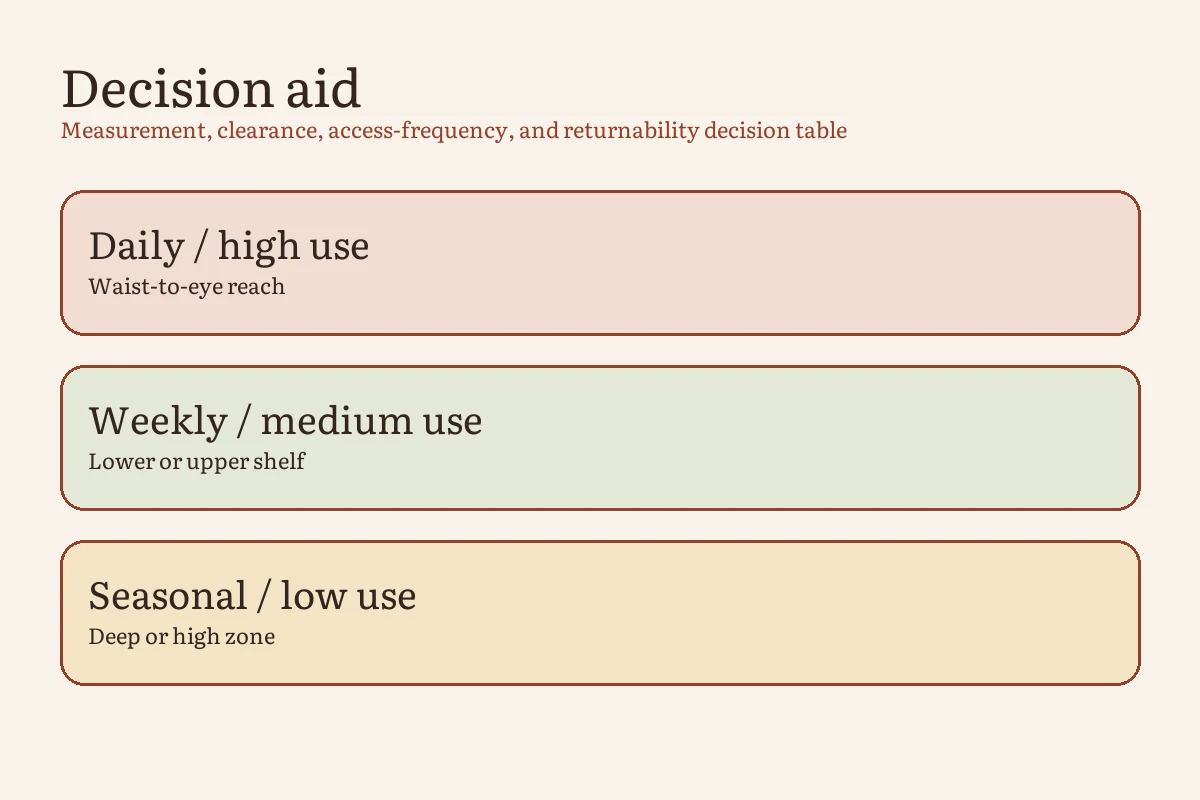
Prefer a stable, dry interior shelf that stays away from leaks, direct sun, radiators, and large temperature or humidity swings. Museum storage guidance treats light, moisture, pests, pollutants, and environmental fluctuation as distinct risks; a household tote cannot eliminate all of them. Avoid a damp basement floor, a hot attic, or a shelf beneath plumbing when a safer interior location exists.
Store the tote level with a label visible from the aisle. Keep it off the floor where a minor leak can reach it. Do not put heavier boxes on top unless the container is designed and loaded to carry that stack without bowing into the ornament layer. If storage is overhead, split the collection so each box is light enough to control and use an appropriate step stool—never a chair.
Create an inventory that speeds up next year’s unpacking
Label each tote with a box number, contents, top orientation, and “fragile” where relevant. Inside, add a printed or digital photo map: row A, cell 1; row A, cell 2; and so on. Mark items with special unpacking instructions, loose caps, or separate hooks. The map prevents exploratory lifting and makes an empty cavity obvious when the season ends.
Keep provenance, maker information, and sentimental notes in a separate envelope or digital record rather than taping them to a fragile surface. For an antique or valuable ornament, record existing cracks and losses before storage. A conservator can advise on custom housing for unstable glass, paint, metal, textile, or mixed materials.
End-of-season closeout checklist
- Every ornament is dry, inspected, and returned to its mapped individual location.
- Loose hooks, batteries, cords, and repair pieces are contained without touching fragile finishes.
- Heavy ornaments occupy the lowest tray or a separate controlled box.
- The lid closes freely, the tote stays level during the lift test, and nothing rattles.
- The shelf is dry, stable, accessible, and clear of leak, heat, light, pest, and crushing risks.
Frequently asked questions
Can I wrap every ornament in tissue paper?
No single paper is compatible with every material and finish. Clean acid-free tissue may suit some objects, but pressure and rubbing can still damage loose paint, glitter, flocking, gilding, or projections. Use original sound packaging or a non-contact custom cavity for sensitive pieces, and seek conservation advice for valuable or unstable objects.
Is a plastic ornament tote better than a cardboard box?
Rigidity, clean condition, stable dividers, lid clearance, manageable weight, and the storage environment matter more than the label. Plastic can resist a brief splash but can also trap an already damp item. Cardboard can provide useful cells but loses strength when wet. Inspect either type before every season.
Should ornaments be stored hanging?
Only when the ornament and purpose-built system are designed for suspended storage and the hanging point can carry the load without distortion. Fragile caps, ribbons, glued loops, and fine wires should not support long-term weight by default.
Sources and editorial method
Every Inch Home created the risk matrix, cell-fit test, packing sequence, and photo-map system for this guide. General fragile-object handling and storage-risk principles were checked against current National Park Service museum guidance. Household ornaments vary widely; maker instructions and a qualified conservator control valuable or unstable pieces.