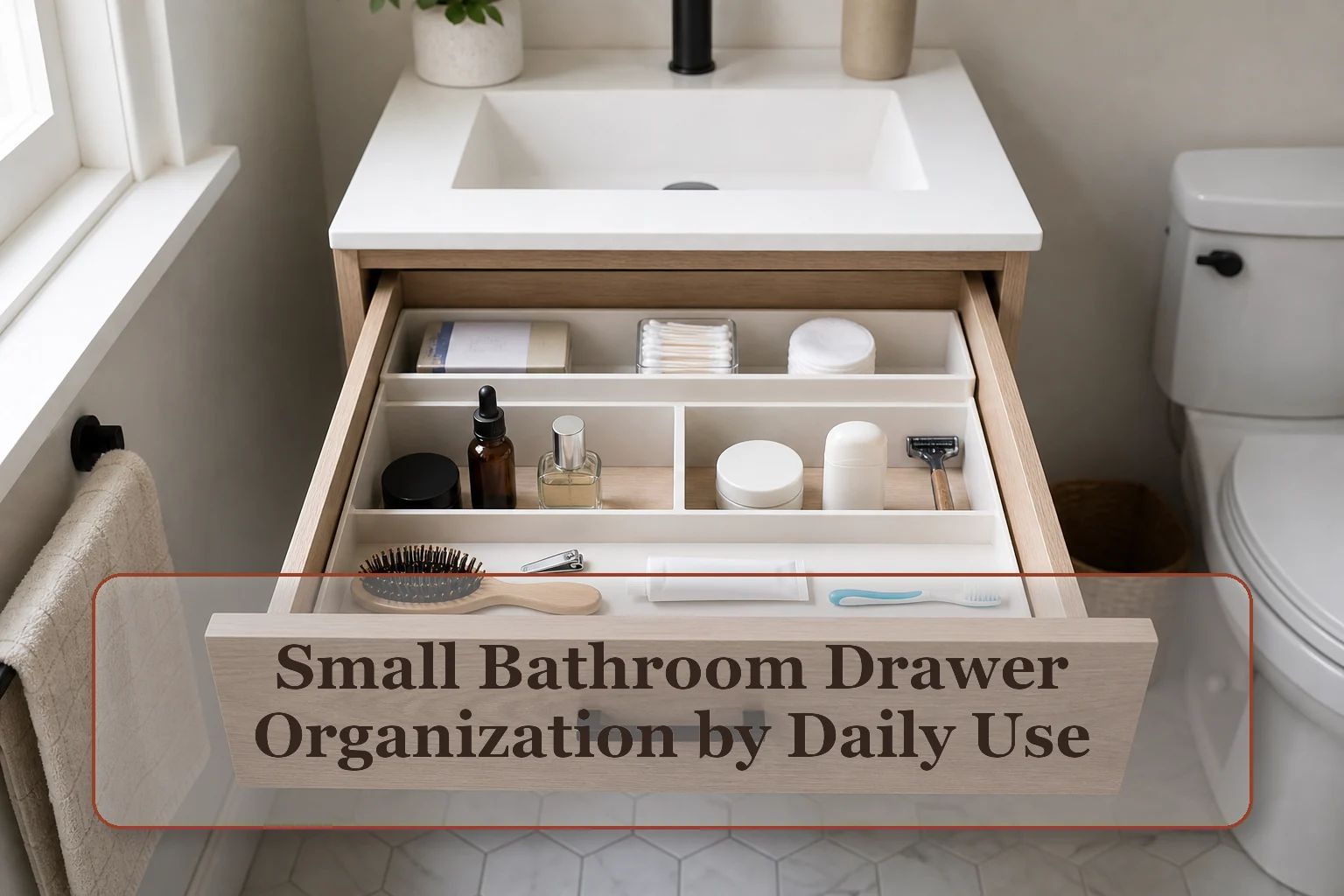
Use the tool: Work toward the drawer map and buying criteria; test it with the real items and route before expanding storage.
Measure the drawer in three dimensions
- Internal footprint: Measure between sidewalls, tracks, handle screws, and any curved or tapered sections. Product listings often use exterior dimensions.
- Closing height: Measure the lowest obstruction above the drawer. Tall bottles and upright brushes fail when the drawer closes, even if the base fits.
- Routine frequency: Lay out one ordinary morning or evening routine. Prime drawer space belongs to the sequence, not to the most attractive packages.
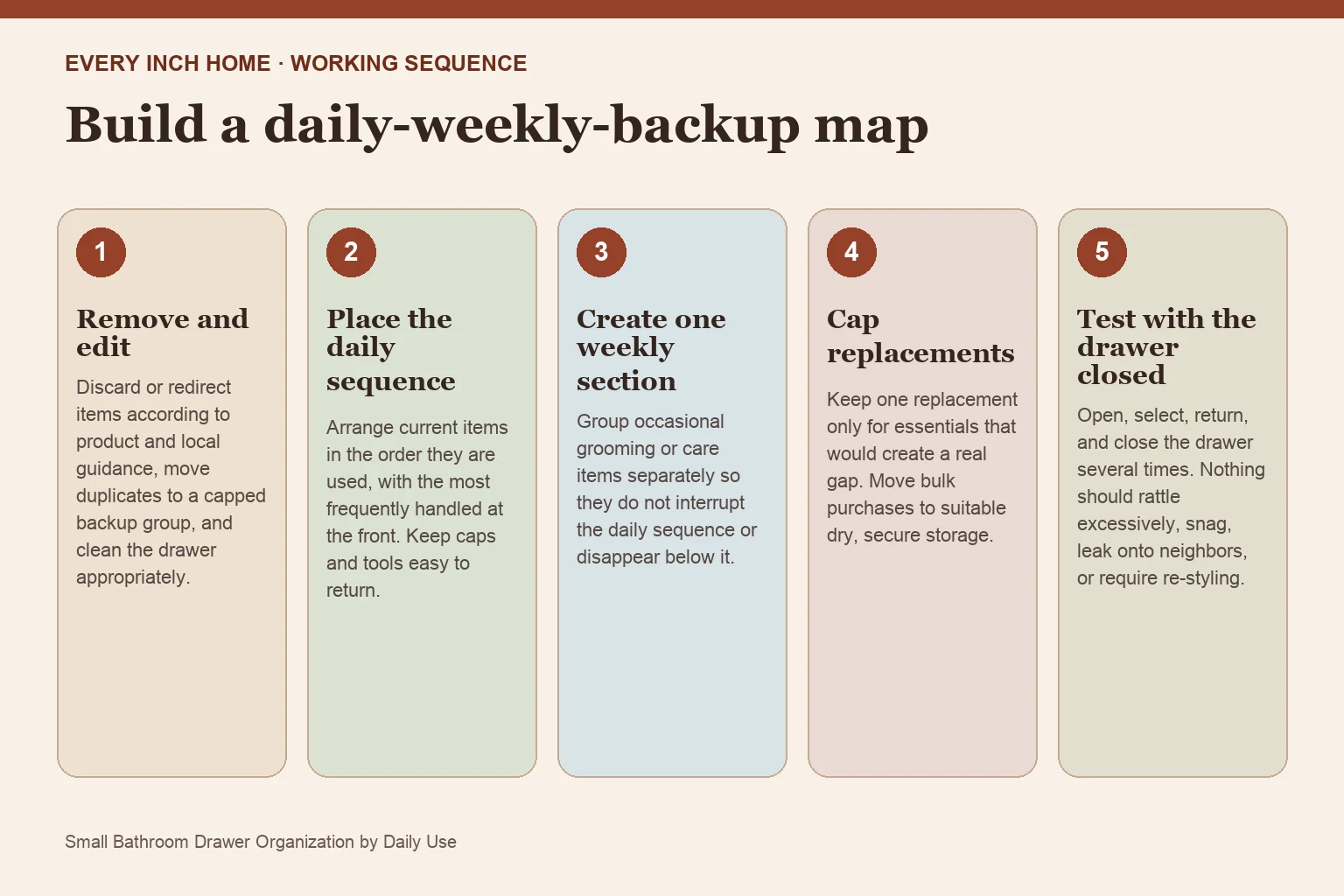
Build a daily-weekly-backup map
1. Remove and edit
Discard or redirect items according to product and local guidance, move duplicates to a capped backup group, and clean the drawer appropriately.
2. Place the daily sequence
Arrange current items in the order they are used, with the most frequently handled at the front. Keep caps and tools easy to return.
3. Create one weekly section
Group occasional grooming or care items separately so they do not interrupt the daily sequence or disappear below it.
4. Cap replacements
Keep one replacement only for essentials that would create a real gap. Move bulk purchases to suitable dry, secure storage.
5. Test with the drawer closed
Open, select, return, and close the drawer several times. Nothing should rattle excessively, snag, leak onto neighbors, or require re-styling.
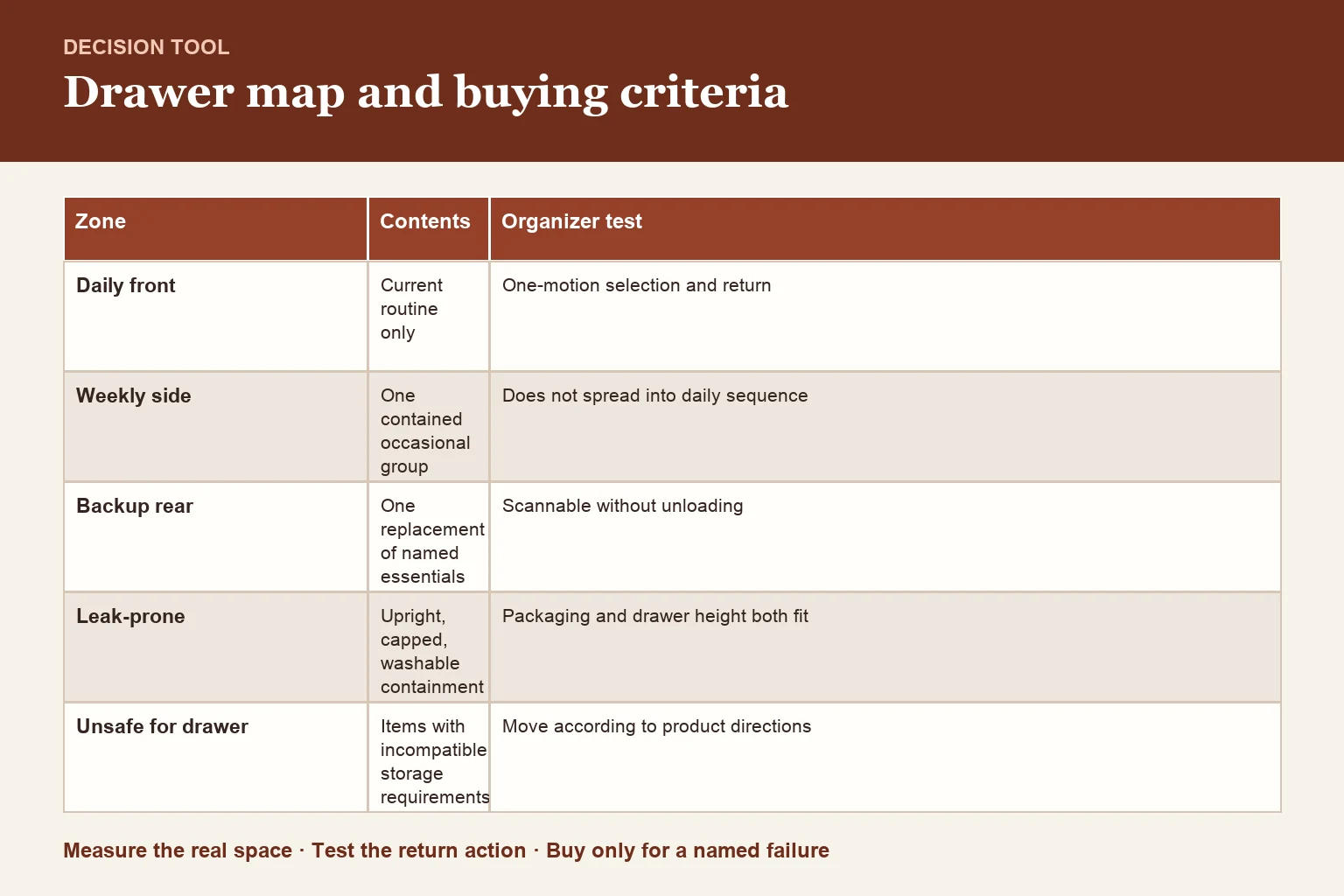
Drawer map and buying criteria
| Zone | Contents | Organizer test |
|---|---|---|
| Daily front | Current routine only | One-motion selection and return |
| Weekly side | One contained occasional group | Does not spread into daily sequence |
| Backup rear | One replacement of named essentials | Scannable without unloading |
| Leak-prone | Upright, capped, washable containment | Packaging and drawer height both fit |
| Unsafe for drawer | Items with incompatible storage requirements | Move according to product directions |
Buy modular pieces, not a guessed full insert
Choose low, washable modules that fit the measured internal dimensions and can change with the routine. Rounded corners, built-in tracks, and plumbing cutouts can reduce usable space. Verify product dimensions and materials. A full-width insert is worthwhile only when its compartments match the actual items rather than forcing new categories.
Reset when a replacement enters the drawer
When a product empties, remove it, clean any residue, bring in the single replacement, and record the next purchase. This cue prevents two open packages and untracked stock. Once a month, remove modules, wipe the drawer, and question samples or tools that have not entered a routine.
Frequently asked questions
How do I organize a very small bathroom drawer?
Give the front to the daily routine, one side to weekly items, and a small rear boundary to essential replacements; keep everything below closing height.
What kind of drawer organizer should I buy?
Use low washable modules that match internal dimensions and real items. Test cardboard footprints before buying.
Can skincare and medicine be kept in a bathroom drawer?
Follow each product's storage directions. Heat, humidity, security, and household access can make another location more appropriate.