Use the tool: Work toward the play, return, and rotate capacity map; test it with the real items and route before expanding storage.
Observe a play-and-reset cycle
- Play: Notice which toys combine in one activity and where play naturally happens. Storage should support the activity, not scatter every set across the room.
- Return: Watch what a child can identify and return with appropriate support. Too many narrow categories can turn cleanup into adult sorting.
- Rotate: Separate intact, currently suitable toys that are not needed in the visible set. Rotation storage must remain secure and appropriate to the household.
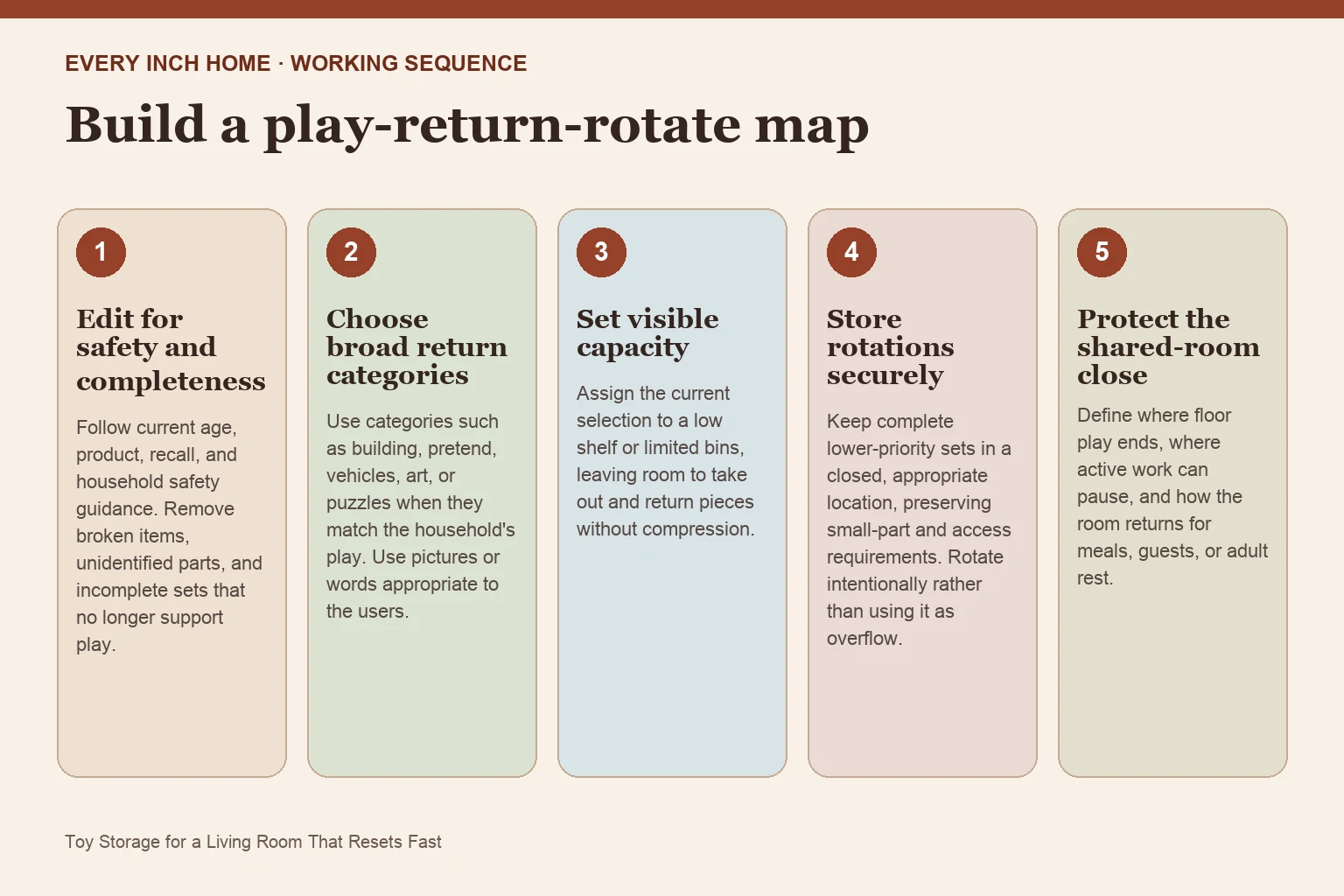
Build a play-return-rotate map
1. Edit for safety and completeness
Follow current age, product, recall, and household safety guidance. Remove broken items, unidentified parts, and incomplete sets that no longer support play.
2. Choose broad return categories
Use categories such as building, pretend, vehicles, art, or puzzles when they match the household's play. Use pictures or words appropriate to the users.
3. Set visible capacity
Assign the current selection to a low shelf or limited bins, leaving room to take out and return pieces without compression.
4. Store rotations securely
Keep complete lower-priority sets in a closed, appropriate location, preserving small-part and access requirements. Rotate intentionally rather than using it as overflow.
5. Protect the shared-room close
Define where floor play ends, where active work can pause, and how the room returns for meals, guests, or adult rest.
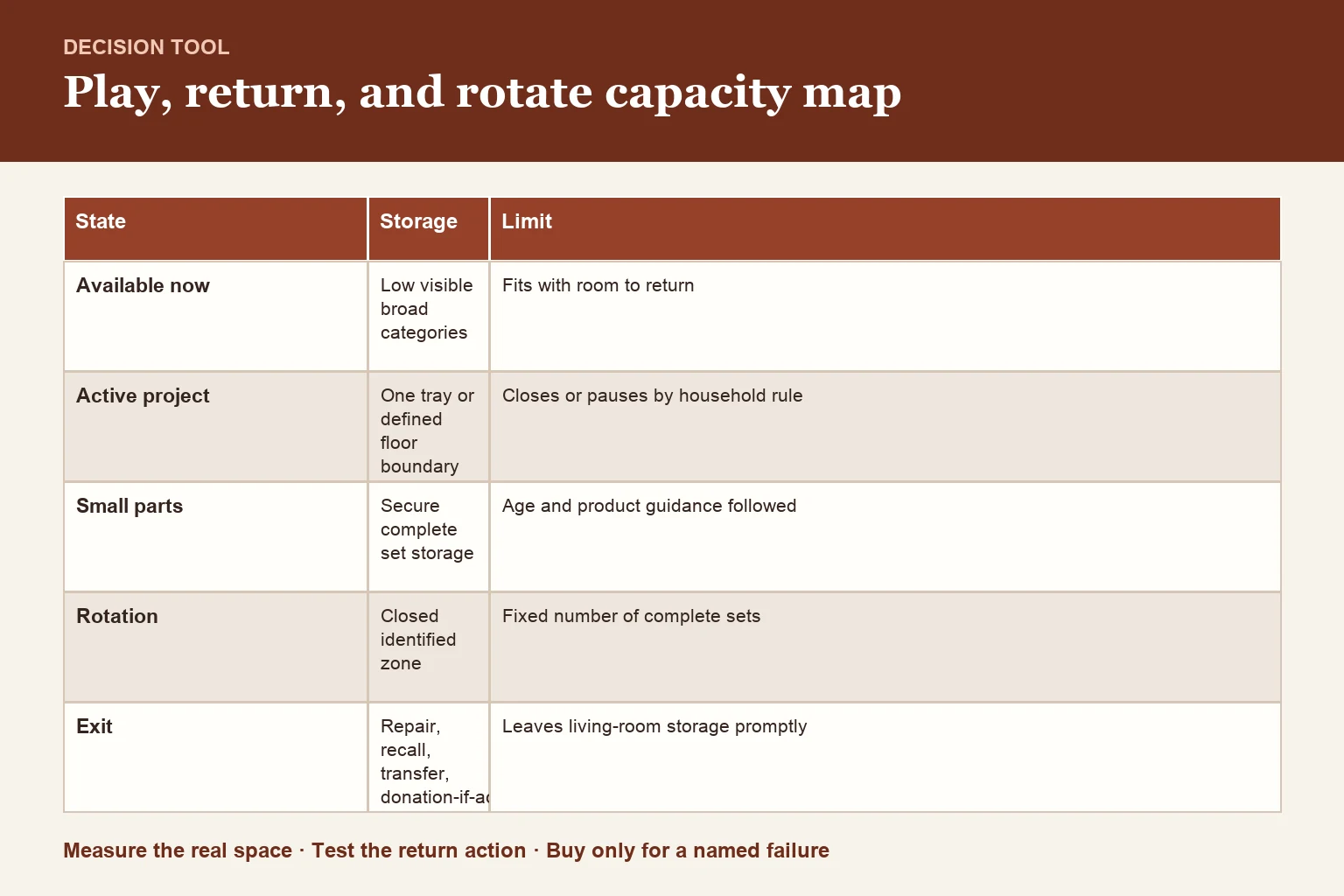
Play, return, and rotate capacity map
| State | Storage | Limit |
|---|---|---|
| Available now | Low visible broad categories | Fits with room to return |
| Active project | One tray or defined floor boundary | Closes or pauses by household rule |
| Small parts | Secure complete set storage | Age and product guidance followed |
| Rotation | Closed identified zone | Fixed number of complete sets |
| Exit | Repair, recall, transfer, donation-if-accepted, or disposal | Leaves living-room storage promptly |
Buying criteria for living-room toy storage
Prioritize stability, anchoring guidance, pinch and tip hazards, rounded access, cleanability, bin weight, child-appropriate height, and current safety information. Verify recalls and product specifications. A closed cabinet can reduce visual noise; open low bins can improve return. Choose based on users and toy types, not a universal look.
Use a song-length or five-minute reset
Return broad categories, reunite obvious sets, place one active project in its pause tray, and clear the shared route. Adults handle unsafe or complex items. If the visible selection cannot reset in about five focused minutes with appropriate help, reduce the number of available toys or simplify categories.
Frequently asked questions
How do I store toys in a living room without it looking cluttered?
Limit the visible selection, use a few broad return categories, place rotations in closed storage, and preserve an open play boundary.
Are open bins or closed cabinets better for toys?
Open bins support recognition and return; closed cabinets reduce visual noise and can secure rotations. Many rooms benefit from a measured mix.
How often should toys be rotated?
Rotate when interest, developmental fit, space, or reset difficulty changes. A fixed calendar is less useful than observing actual play.