Use the tool: Work toward the usable-width worksheet; test it with the real items and route before expanding storage.
Calculate usable entry width
- Narrowest point: Measure between walls, trim, radiator, furniture, and the open door—not at the widest point of the hall.
- Active swing: Trace the full front-door, closet-door, and cabinet-door arcs plus room for a person and bag. Storage should not turn entry into a sequence of closures.
- Daily count: Count the current pairs that actually arrive during one week. The entry is a transfer zone, not the whole shoe collection.
Fit a shoe boundary into the leftover depth
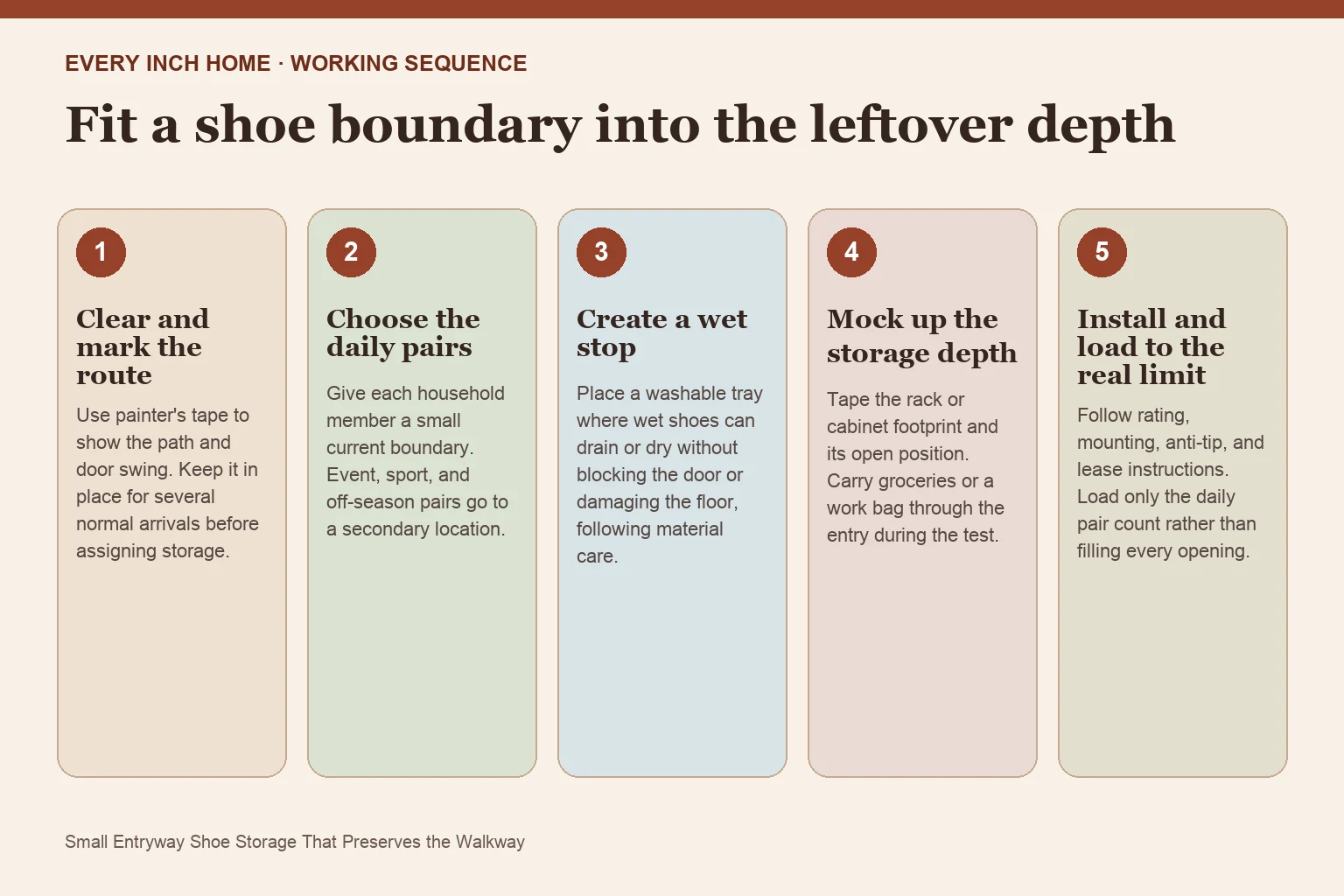
1. Clear and mark the route
Use painter's tape to show the path and door swing. Keep it in place for several normal arrivals before assigning storage.
2. Choose the daily pairs
Give each household member a small current boundary. Event, sport, and off-season pairs go to a secondary location.
3. Create a wet stop
Place a washable tray where wet shoes can drain or dry without blocking the door or damaging the floor, following material care.
4. Mock up the storage depth
Tape the rack or cabinet footprint and its open position. Carry groceries or a work bag through the entry during the test.
5. Install and load to the real limit
Follow rating, mounting, anti-tip, and lease instructions. Load only the daily pair count rather than filling every opening.
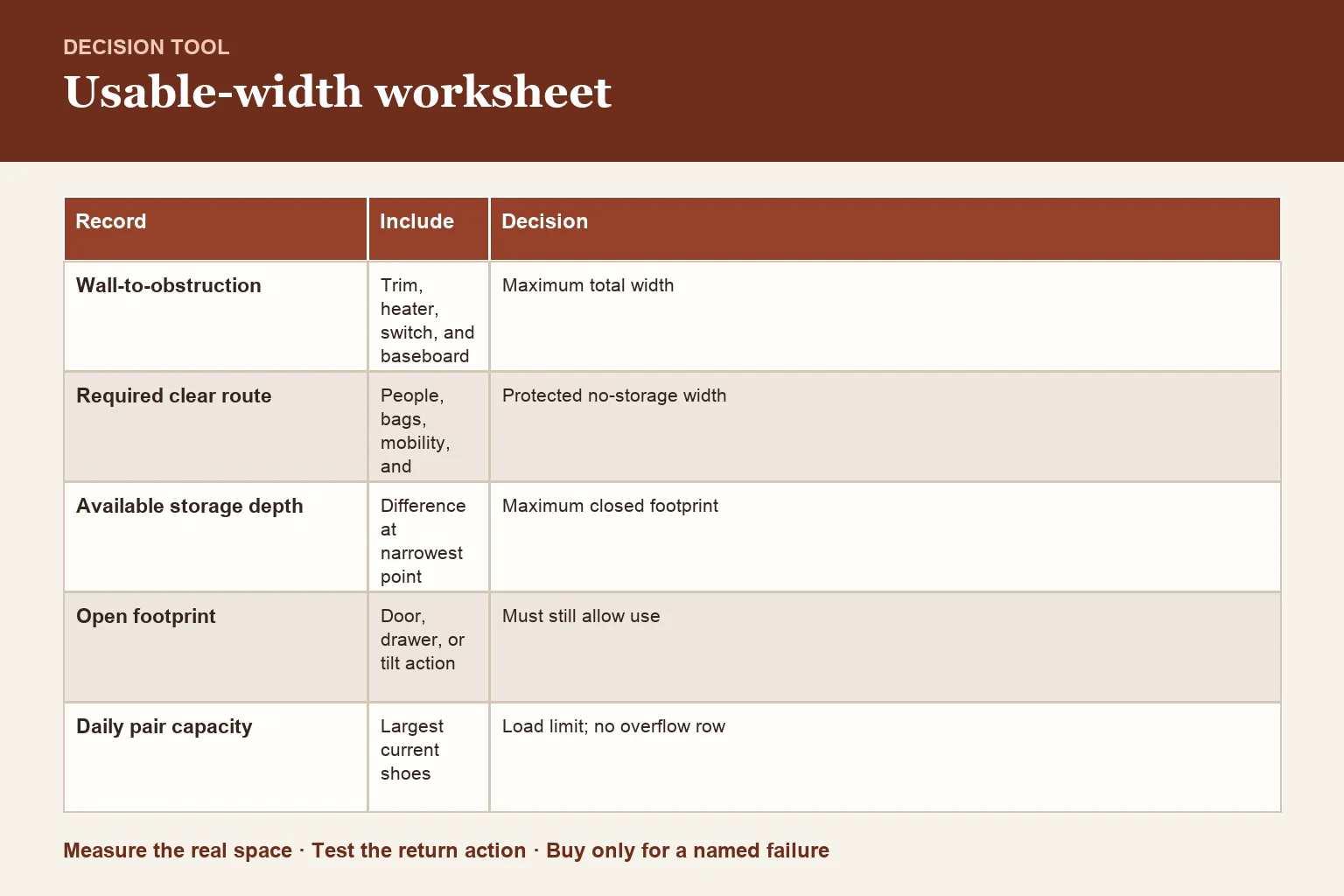
Usable-width worksheet
| Record | Include | Decision |
|---|---|---|
| Wall-to-obstruction | Trim, heater, switch, and baseboard | Maximum total width |
| Required clear route | People, bags, mobility, and emergencies | Protected no-storage width |
| Available storage depth | Difference at narrowest point | Maximum closed footprint |
| Open footprint | Door, drawer, or tilt action | Must still allow use |
| Daily pair capacity | Largest current shoes | Load limit; no overflow row |
A narrow cabinet still needs open-space clearance
Verify both closed and operating depth, shelf or compartment size, ventilation, base stability, anti-tip instructions, and the height of the largest footwear. If opening the cabinet blocks the front door or leaves no standing room, choose an open rack, a different wall, or fewer daily pairs.
Rotate the entry with weather, not clutter
At the end of the week, return dry occasional shoes, clean the tray as appropriate, reunite pairs, and switch footwear when the weather changes. Keep the daily limit fixed. A new pair entering the arrival zone replaces a position rather than creating floor parking.
Frequently asked questions
How narrow can an entryway shoe cabinet be?
It must fit your largest shoes and operating mechanism while preserving the required path. Measure the actual entry and product; there is no universal safe depth.
Where should wet shoes go in a small entry?
Use a stable washable tray in a ventilated spot clear of door swing and walking space, then move shoes after they dry according to care guidance.
How do I stop shoes spreading across the entry?
Set a daily-pair limit per person, give the limit a physical rack or tray boundary, and return occasion shoes after use.