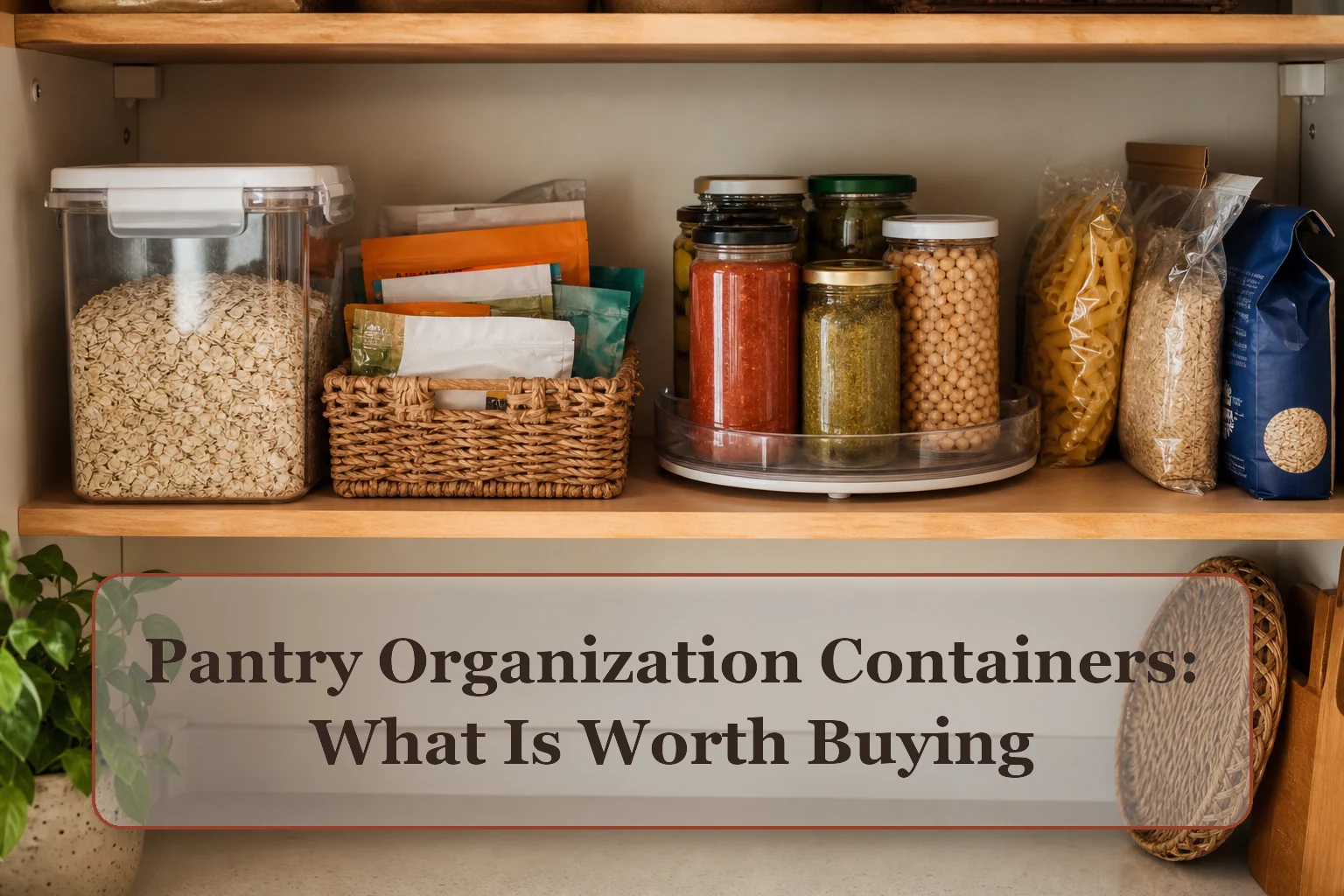
Use the tool: Work toward the food-type and container buying criteria; test it with the real items and route before expanding storage.
Name the failure before the container
- Freshness or pest protection: An opened dry food may benefit from a food-safe container with a dependable seal. Match capacity to the full package, not the last half of it.
- Visibility: Packets and short jars can disappear behind larger packages. A low basket, riser, or turntable may improve the sight line without decanting.
- Handling: If a heavy bin or tall stack must be unloaded to reach one ingredient, containment has made retrieval worse. Weight and grip space are part of fit.
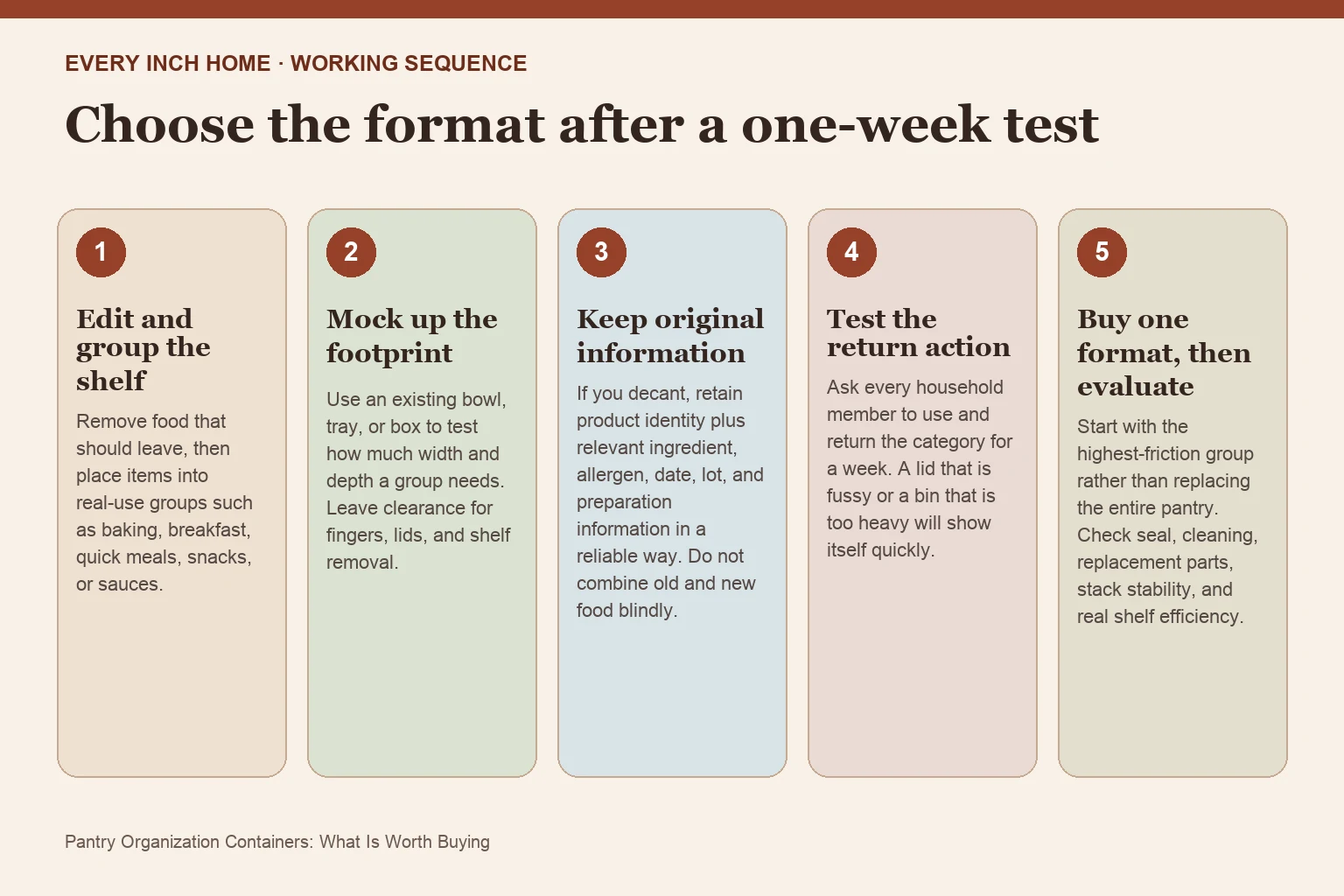
Choose the format after a one-week test
1. Edit and group the shelf
Remove food that should leave, then place items into real-use groups such as baking, breakfast, quick meals, snacks, or sauces.
2. Mock up the footprint
Use an existing bowl, tray, or box to test how much width and depth a group needs. Leave clearance for fingers, lids, and shelf removal.
3. Keep original information
If you decant, retain product identity plus relevant ingredient, allergen, date, lot, and preparation information in a reliable way. Do not combine old and new food blindly.
4. Test the return action
Ask every household member to use and return the category for a week. A lid that is fussy or a bin that is too heavy will show itself quickly.
5. Buy one format, then evaluate
Start with the highest-friction group rather than replacing the entire pantry. Check seal, cleaning, replacement parts, stack stability, and real shelf efficiency.
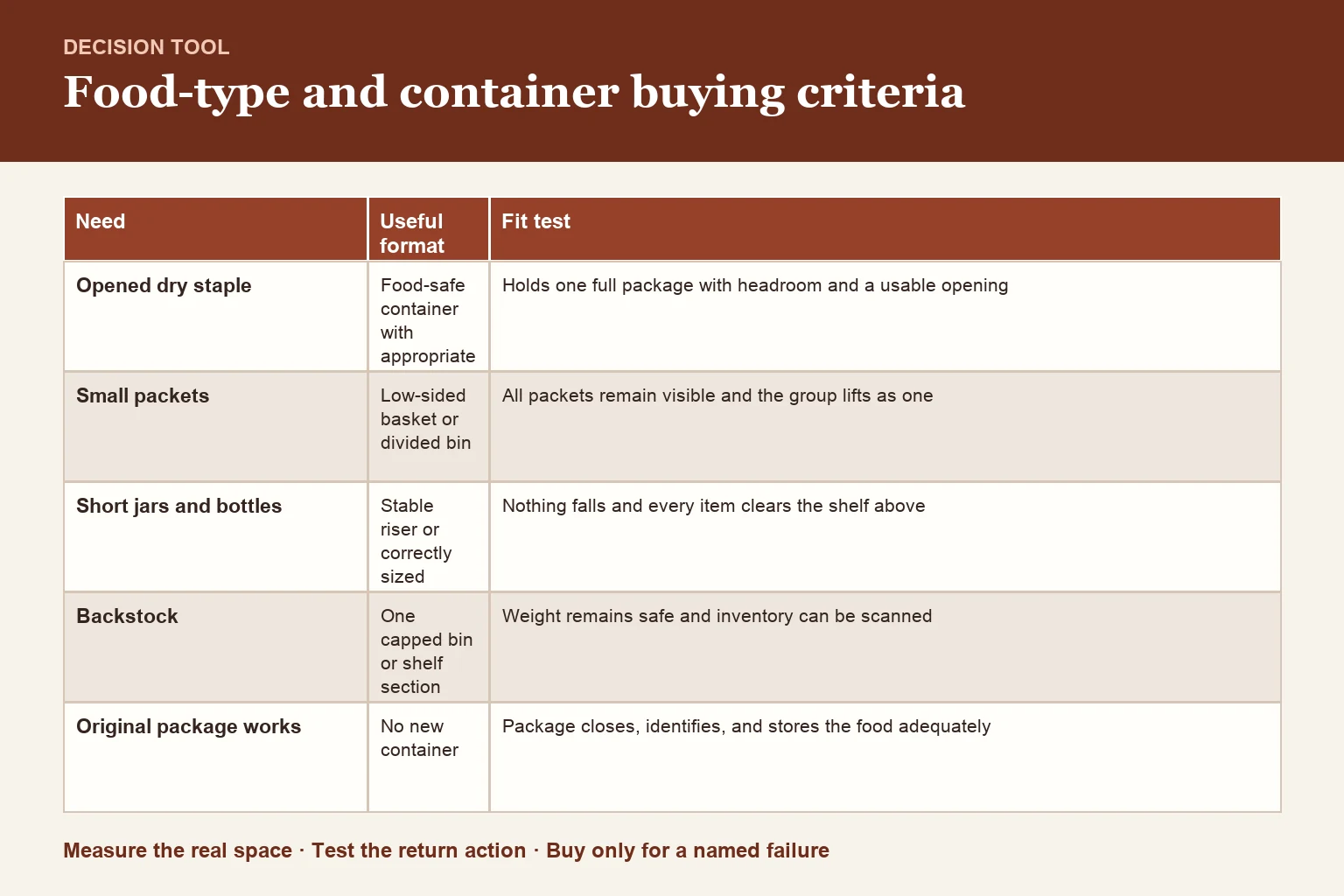
Food-type and container buying criteria
| Need | Useful format | Fit test |
|---|---|---|
| Opened dry staple | Food-safe container with appropriate seal | Holds one full package with headroom and a usable opening |
| Small packets | Low-sided basket or divided bin | All packets remain visible and the group lifts as one |
| Short jars and bottles | Stable riser or correctly sized turntable | Nothing falls and every item clears the shelf above |
| Backstock | One capped bin or shelf section | Weight remains safe and inventory can be scanned |
| Original package works | No new container | Package closes, identifies, and stores the food adequately |
What this guide is—and is not—recommending
This is product-fit guidance, not a claim that one brand or matching set is best. Prioritize food-contact suitability, seal performance appropriate to the food, stable stacking only where the manufacturer permits it, an opening you can clean, replacement-lid availability, and dimensions that work on your shelf. Verify current product specifications before purchase.
Reconcile containers before grocery shopping
Once a week, check open containers against backstock and the shopping list. Clean spills, preserve dates and identification, and avoid topping a new package onto an unknown older remainder. If a container stays empty or continually holds the wrong item, return the shelf space instead of inventing a new category for it.
Frequently asked questions
Should I put all pantry food in containers?
No. Original packaging is often the simplest safe choice. Decant when it meaningfully improves seal, handling, or visibility and you can preserve essential product information.
Are square pantry containers better than round ones?
Square shapes can use shelf width efficiently; round containers can be comfortable to scoop and suit turntables. Shelf fit, opening, seal, and cleaning matter more than shape alone.
How do I know what size pantry container to buy?
Measure the shelf, the full unopened package volume, the container opening, and the lift-off clearance. Test one group before buying a set.